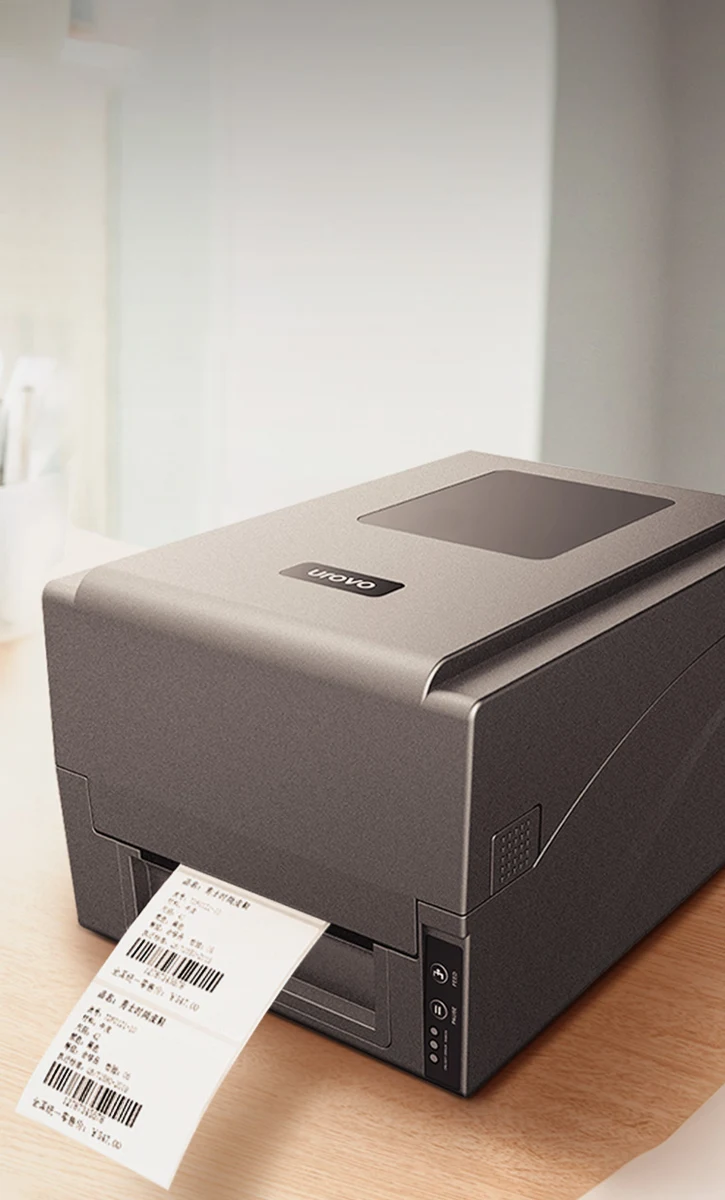
UROVO / Label and receipt printers
D7100 Series: Label and receipt printers
UROVO D7100 Series is a thermal barcode printer for warehouse, logistics and manufacturing label workflows. The official page lists thermal-transfer and direct-thermal modes, 203 or 300 dpi options, serial/USB/parallel interfaces with optional Ethernet, Wi-Fi or Bluetooth, and up to 152 mm/s printing. The exact printer, media and interface configuration should be confirmed before ordering.
Suggested profiles: warehouse, logistics and manufacturing label printing with a defined media and host configuration
- Memory
- 8 MB RAM; 4 MB or 8 MB flash options listed
- Power input
- AC 110 V/240 V
- Dimensions
- 278 x 210 x 180 mm
- Weight
- 2.3 kg
- Power output
- DC 24 V / 2.5 A, 60 W
- Printer method
- Thermal transfer and direct thermal modes listed
The exact model, regional configuration and commercial terms require project confirmation.
Browse by device capability
D7100 Series / Browse by device capability
UROVO is the primary established product resource, with SEUIC (Dongji) and selected platforms used where the capture method, form factor or deployment requirement needs another option. Published models follow an evidence, regional-configuration and RuggedLayer validation path.
Suggested profiles
- Warehouse and shipping labels
- Manufacturing traceability and compliance labels
- Workstations that need a configurable thermal-transfer or direct-thermal printer
Browse by device capability
- A desktop thermal printer format for defined warehouse, logistics and manufacturing label stations.
- Thermal-transfer and direct-thermal modes support different label and ribbon requirements.
- 203/300 dpi options, long print length and 20-120 mm media cover a broad label-format starting point.
- Optional network and wireless interfaces require exact host, printer and regional configuration confirmation.
How a device enters the portfolio
Key specifications
Manufacturer-listed configuration; confirm the exact variant before ordering.
Platform
| Memory | 8 MB RAM; 4 MB or 8 MB flash options listed |
|---|---|
| Operating conditions | 5-45 C; 25-85% RH, non-condensing |
| Storage conditions | -10 to +50 C; 10-90% RH, non-condensing |
Power and physical
| Dimensions | 278 x 210 x 180 mm |
|---|---|
| Weight | 2.3 kg |
| Power input | AC 110 V/240 V |
| Power output | DC 24 V / 2.5 A, 60 W |
| Interfaces | Standard serial, USB and parallel interfaces; optional Ethernet, Wi-Fi and Bluetooth |
Environmental
| Maximum internal roll | 130 mm outside diameter |
|---|
Other configuration
| Printer method | Thermal transfer and direct thermal modes listed |
|---|---|
| Print speed | Up to 152 mm/s |
| Print-head resolution | 203 dpi or 300 dpi options |
| Maximum print width | 104 mm |
| Maximum print length | 2286 mm / 90 inches |
| Media | Continuous, gap, fan-fold and black-mark paper listed |
| Media width | 20-120 mm |
| Ribbon | 30-110 mm width, up to 67 mm diameter and 300 m length |
A final shortlist depends on the application, scan or RFID workload, operating environment, country, deployment volume and support expectations.
A clear handoff at every layer
Five service layers for a more predictable device program.
RuggedLayer organizes access to multiple manufacturers into a consistent engagement model. Each layer has a defined input, deliverable and evidence boundary.
Service layers
- Choose the print method, head resolution, media, ribbon, sensor and interface combination from the label specification.
- Confirm the AC power configuration, host protocol, print language, network option and mounting or cable arrangement for the destination.
- Validate print quality, alignment, media sensing, queue recovery and maintenance access with the exact printer and label stock.
Deployment accessories
- Scope the power supply, ribbon and media holders, USB or network cabling, mounting and maintenance parts with the printer.
- Keep approved label and ribbon samples, templates, calibration settings and interface profiles versioned with the deployment handover.
RuggedLayer Test Lab
Define a useful test, not a vague benchmark.
Tell us the labels, tags, application and operating conditions that matter.
- 01
Print representative text, graphics and barcodes at both resolution options, required media widths and target speeds.
- 02
Test media sensing, ribbon handling, calibration, alignment, interface reconnect and offline queue recovery.
- 03
Freeze the printer configuration, power, media, ribbon, template, maintenance process and acceptance limits before rollout.
Project intake
D7100 Series / Start with enough context to make the next step useful.
Choose the closest project intent and describe only non-confidential workflow, application and deployment requirements.