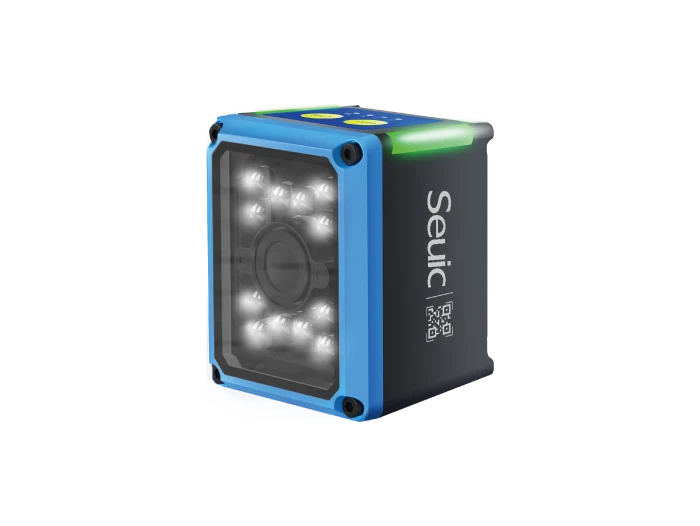
SEUIC (Dongji) / Visual readers
X4 AI: Visual readers
SEUIC (Dongji) X4 AI is a fixed industrial vision reader for automated barcode capture and inspection stations. The official page lists a 1.3 MP global-shutter sensor, adjustable focus, red or white lighting, Ethernet industrial protocols, configurable I/O and IP67 protection.
Suggested profiles: automated barcode capture, traceability and industrial inspection stations
- Power
- 10-30 V DC; 0.5-1.5 A listed
- Protection
- IP67 enclosure rating
- Dimensions
- 61.2 x 48.7 x 45.55 mm
- Image sensor
- 1.3 MP CMOS global shutter, 1280 x 1024 pixels
- Lighting
- High-intensity red LED or white LED
- Aimer
- Class II laser dual-point positioning aimer listed by the manufacturer
The exact model, regional configuration and commercial terms require project confirmation.
Browse by device capability
X4 AI / Browse by device capability
UROVO is the primary established product resource, with SEUIC (Dongji) and selected platforms used where the capture method, form factor or deployment requirement needs another option. Published models follow an evidence, regional-configuration and RuggedLayer validation path.
Suggested profiles
- Production traceability and serialization
- Packaging and parcel verification stations
- Automated workstations with PLC or industrial-network integration
Browse by device capability
- Global-shutter imaging, adjustable focus and selectable lighting support fixed capture stations.
- Industrial Ethernet protocols and discrete I/O enable integration with automation controllers.
- X4 and X4W focus ranges address different working distances and fields of view.
- IP67 protection is manufacturer-listed; optics, lighting and wiring still require station validation.
How a device enters the portfolio
Key specifications
Manufacturer-listed configuration; confirm the exact variant before ordering.
Data capture
| Image sensor | 1.3 MP CMOS global shutter, 1280 x 1024 pixels |
|---|
Power and physical
| Code support | 1D Code 128, GS1-128, Code 39, Code 93, Codabar, Interleaved 2 of 5, EAN/UPC; 2D QR, DataMatrix and PDF417 families |
|---|---|
| Dimensions | 61.2 x 48.7 x 45.55 mm |
| Weight | Approximately 220 g |
| Power | 10-30 V DC; 0.5-1.5 A listed |
Environmental
| Protection | IP67 enclosure rating |
|---|---|
| Environment | Operating 0-50 C; storage -20 to +70 C; 5-95% RH non-condensing |
Other configuration
| Lighting | High-intensity red LED or white LED |
|---|---|
| Aimer | Class II laser dual-point positioning aimer listed by the manufacturer |
| Focus range | X4 AI standard: 50-1000 mm adjustable; X4W AI wide view: 50-500 mm adjustable |
| Minimum resolution | 1D 3.3 mil; 2D 2.0 mil listed |
| Ethernet | TCP/UDP, FTP, Profinet, Ethernet/IP, Modbus TCP, FINS and MELSEC protocols listed |
| USB | USB 2.0 Full Speed compliant |
| Control input | Two bidirectional voltage inputs, maximum 30 V |
| Control output | Three optocoupler outputs, maximum 30 V; current limits are configuration dependent |
| Ambient light | 0-10,000 lux listed |
A final shortlist depends on the application, scan or RFID workload, operating environment, country, deployment volume and support expectations.
A clear handoff at every layer
Five service layers for a more predictable device program.
RuggedLayer organizes access to multiple manufacturers into a consistent engagement model. Each layer has a defined input, deliverable and evidence boundary.
Service layers
- Choose standard or wide-view focus, lens position, lighting, trigger, I/O and industrial protocol with the machine builder.
- Confirm laser safety controls, enclosure, cable routing, network segmentation and firmware behavior for the installation.
- Test codes, surfaces, speed, vibration, glare, ambient light and reject handling at the production line.
Deployment accessories
- Scope lens or focus configuration, lighting, mounting bracket, trigger wiring, Ethernet or USB cable and power supply.
- Keep the PLC mapping, code profile, image-retention rule and maintenance access requirements in the station handover.
RuggedLayer Test Lab
Define a useful test, not a vague benchmark.
Tell us the labels, tags, application and operating conditions that matter.
- 01
Run the full code set at target line speed, distance, angle, lighting and surface conditions.
- 02
Verify trigger timing, I/O states, protocol messages, duplicate handling, reject signals and network recovery.
- 03
Record the selected focus, lighting, firmware, wiring, protocol and acceptance result before production release.
Project intake
X4 AI / Start with enough context to make the next step useful.
Choose the closest project intent and describe only non-confidential workflow, application and deployment requirements.