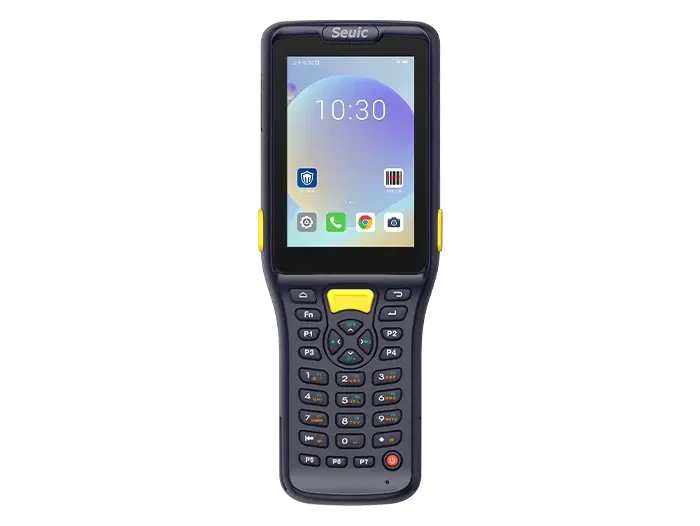
SEUIC (Dongji) / Keypad mobile terminals
AUTOID Q7-S: Keypad mobile terminals
SEUIC (Dongji) AUTOID Q7-S is a keypad Android handheld for warehouse sorting, inventory and retail scanning. The official Q7-(S) page lists physical scan keys, hot-swappable power, 4G, glove touch, optional 1D/2D scan engines and IP65 protection with a 1.8 m drop reference.
Suggested profiles: warehouse sorting, inventory, retail and scan-intensive operator workflows
- Operating system
- Android 9.0
- Memory
- 2 GB RAM / 32 GB flash or 4 GB RAM / 64 GB flash
- Display
- 3.5 inch, 960 x 640 pixels, typical 350 nit; glove and wet-hand touch modes listed
- Scanning
- Optional 1D laser, advanced laser or 2D image scan engines; exact engine must be selected
- Battery
- Removable 4850 mAh lithium-ion battery with hot-swap support
- Protection
- IP65; manufacturer lists a 1.8 m drop reference and 0.5 m rolling tests
Browse by device capability
AUTOID Q7-S / Browse by device capability
UROVO is the primary established product resource, with SEUIC (Dongji) and selected platforms used where the capture method, form factor or deployment requirement needs another option. Published models follow an evidence, regional-configuration and RuggedLayer validation path.
Suggested profiles
- Distribution sorting and receiving
- Warehouse cycle counts and replenishment
- Retail inventory and scan-heavy store operations
Browse by device capability
- Physical keys and dedicated scan controls suit repetitive warehouse work and gloved operators.
- A removable 4850 mAh battery and hot-swap support can be planned around two-shift operations.
- Optional scan engines allow the code profile and working distance to be matched to the application.
- The source page uses Q7-(S) naming; the ordered commercial SKU must preserve that model boundary.
How a device enters the portfolio
Key specifications
Manufacturer-listed configuration; confirm the exact variant before ordering.
Platform
| Operating system | Android 9.0 |
|---|---|
| Processor | MTK6762 octa-core, 2.0 GHz |
| Display | 3.5 inch, 960 x 640 pixels, typical 350 nit; glove and wet-hand touch modes listed |
| Memory | 2 GB RAM / 32 GB flash or 4 GB RAM / 64 GB flash |
Data capture
| Scanning | Optional 1D laser, advanced laser or 2D image scan engines; exact engine must be selected |
|---|
Connectivity
| Wireless | 4G WWAN and WLAN; Mini SIM and Micro SD expansion are listed |
|---|
Power and physical
| Battery | Removable 4850 mAh lithium-ion battery with hot-swap support |
|---|
Environmental
| Protection | IP65; manufacturer lists a 1.8 m drop reference and 0.5 m rolling tests |
|---|---|
| Environment | Operating -20 to +50 C; storage -40 to +70 C without battery |
Other configuration
| Input | On-screen keyboard plus physical power and scan keys |
|---|---|
| Physical | 190 x 70 x 26 mm excluding side buttons; approximately 310 g including battery |
| Capture and feedback | Dedicated scan controls, alert sound, multi-color LED and vibration feedback |
A final shortlist depends on the application, scan or RFID workload, operating environment, country, deployment volume and support expectations.
A clear handoff at every layer
Five service layers for a more predictable device program.
RuggedLayer organizes access to multiple manufacturers into a consistent engagement model. Each layer has a defined input, deliverable and evidence boundary.
Service layers
- Select the scan engine, key map, memory, SIM, Micro SD, battery and cradle for the actual shift and code set.
- Test gloves, wet touch, paper and screen codes, scan distance, physical-key ergonomics and MDM enrollment.
- Confirm Android lifecycle, regional radio bands, cleaning procedure, certification and spare-battery handling.
Deployment accessories
- Scope spare batteries, cradle or charger, hand strap, protective cover and optional scan handle around the shift plan.
- Keep the key mapping, scan profile, MDM policy, radio configuration and approved accessory list with the handover.
RuggedLayer Test Lab
Define a useful test, not a vague benchmark.
Tell us the labels, tags, application and operating conditions that matter.
- 01
Measure first-pass reads and duplicate handling for target 1D/2D codes at distance, angle, motion and lighting.
- 02
Test battery rotation, charging, radio roaming, physical keys, application recovery and offline synchronization.
- 03
Freeze the exact Q7-(S) SKU, OS, firmware, scanner, accessories and acceptance limits before rollout.
Project intake
AUTOID Q7-S / Start with enough context to make the next step useful.
Choose the closest project intent and describe only non-confidential workflow, application and deployment requirements.