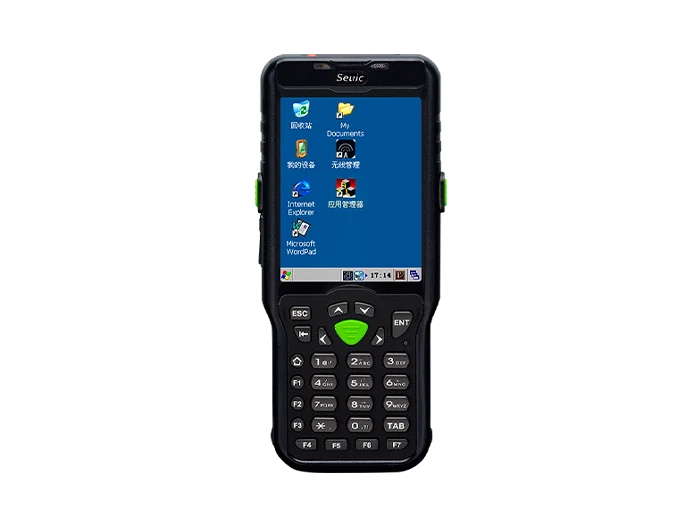
SEUIC (Dongji) / Keypad mobile terminals
AUTOID 6L-W: Keypad mobile terminals
SEUIC (Dongji) AUTOID 6L-W is a keypad Windows CE handheld for long-running indoor warehouse and high-load scanning operations. The official page lists a backlit 28-key layout, removable battery, dual-band Wi-Fi, optional 1D/2D scan engines, IP65 protection and a 1.5 m drop reference.
Suggested profiles: indoor warehouse, high-load data capture and legacy Windows CE workflows
- Operating system
- Microsoft Windows CE 6.0
- Memory
- 512 MB RAM / 512 MB ROM with 4 GB internal storage listed
- Display
- 3.5 inch industrial color LCD, QVGA 240 x 320 pixels
- Scanning
- Optional 1D laser, advanced laser or 2D scan engines; exact option requires confirmation
- Battery
- Removable 3.7 V 3800 mAh battery with a non-removable 100 mAh backup battery
- Protection
- IP65; manufacturer lists 1.5 m drops and 0.5 m rolling impact testing
Browse by device capability
AUTOID 6L-W / Browse by device capability
UROVO is the primary established product resource, with SEUIC (Dongji) and selected platforms used where the capture method, form factor or deployment requirement needs another option. Published models follow an evidence, regional-configuration and RuggedLayer validation path.
Suggested profiles
- Indoor warehouse receiving and putaway
- Legacy Windows CE inventory applications
- High-load scan work with physical key operation
Browse by device capability
- A physical keypad and backlight suit repetitive indoor work where gloves and fast key entry matter.
- Windows CE can fit an existing legacy capture application when its deployment and security constraints are accepted.
- Removable power, a backup battery and IP65 protection support long-running warehouse use.
- The older OS, memory ceiling and optional scanner make application compatibility a release gate.
How a device enters the portfolio
Key specifications
Manufacturer-listed configuration; confirm the exact variant before ordering.
Platform
| Operating system | Microsoft Windows CE 6.0 |
|---|---|
| Processor | ARM Cortex-A8, 1 GHz |
| Memory | 512 MB RAM / 512 MB ROM with 4 GB internal storage listed |
| Display | 3.5 inch industrial color LCD, QVGA 240 x 320 pixels |
Data capture
| Scanning | Optional 1D laser, advanced laser or 2D scan engines; exact option requires confirmation |
|---|
Connectivity
| Wireless | IEEE 802.11 b/g/n WLAN; exact radio and security profile require host review |
|---|
Power and physical
| Battery | Removable 3.7 V 3800 mAh battery with a non-removable 100 mAh backup battery |
|---|---|
| Interface | Micro USB with USB 2.0 High Speed; dedicated charger and PC USB charging are listed |
Environmental
| Protection | IP65; manufacturer lists 1.5 m drops and 0.5 m rolling impact testing |
|---|---|
| Environment | Operating -20 to +50 C; storage -40 to +60 C; 5-95% RH non-condensing |
Other configuration
| Keyboard | 28 backlit physical keys |
|---|---|
| Physical | 169 x 72 x 36 mm excluding side buttons; approximately 313 g including battery |
A final shortlist depends on the application, scan or RFID workload, operating environment, country, deployment volume and support expectations.
A clear handoff at every layer
Five service layers for a more predictable device program.
RuggedLayer organizes access to multiple manufacturers into a consistent engagement model. Each layer has a defined input, deliverable and evidence boundary.
Service layers
- Confirm the Windows CE application, drivers, security controls, Wi-Fi authentication and scan engine before a pilot.
- Test key ergonomics, scan distance, battery charging, backup-battery behavior, roaming and offline recovery.
- Plan lifecycle, spare parts, recovery media and migration risk because Windows CE is a legacy platform.
Deployment accessories
- Scope the dedicated charger, spare batteries, hand strap, protective parts and scan-engine option for the shift plan.
- Keep the Windows CE image, application installer, Wi-Fi profile, key map and recovery procedure with the handover.
RuggedLayer Test Lab
Define a useful test, not a vague benchmark.
Tell us the labels, tags, application and operating conditions that matter.
- 01
Run the actual Windows CE application against target labels, host systems and Wi-Fi authentication.
- 02
Measure scan success, key input, battery turnaround, roaming, backup recovery and offline synchronization.
- 03
Freeze the exact scanner, OS image, firmware, network profile, accessories and lifecycle acceptance record.
Project intake
AUTOID 6L-W / Start with enough context to make the next step useful.
Choose the closest project intent and describe only non-confidential workflow, application and deployment requirements.