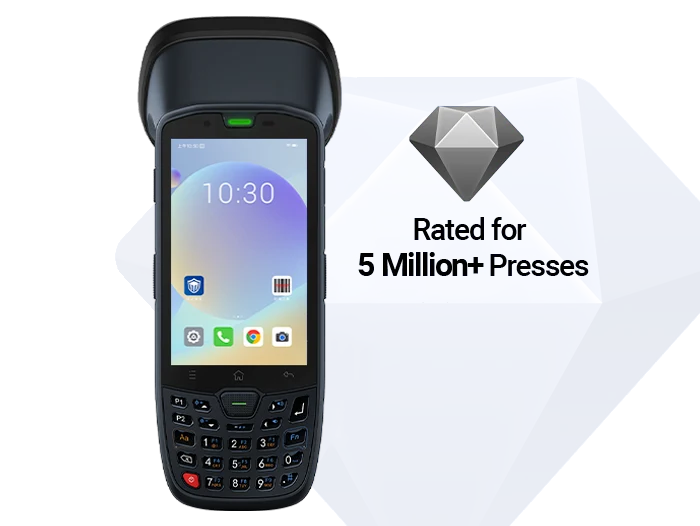
SEUIC (Dongji) / Keypad mobile terminals
AUTOID 10-DPM: Keypad mobile terminals
SEUIC (Dongji) AUTOID 10-DPM is a keypad Android handheld focused on direct-part-marking and difficult-code capture. The official page lists a dedicated DP/HDP scan configuration, adaptive red, white and blue illumination, 27 backlit keys, Android 14 and IP65 protection.
Suggested profiles: direct-part-marking, manufacturing traceability and difficult-code workflows
- Operating system
- Android 14 with GMS and AER listed
- Memory
- 4 GB LPDDR4 RAM / 64 GB UFS 2.1 ROM
- Display
- 4 inch WVGA, 800 x 480 pixels
- Scanning
- DP and HDP scan engine for direct-part-marking use
- Battery
- Optional detachable 5360 mAh battery with 50 mAh backup battery; 18 W fast charging listed
- Bluetooth
- Bluetooth 5.1 with BLE support
Browse by device capability
AUTOID 10-DPM / Browse by device capability
UROVO is the primary established product resource, with SEUIC (Dongji) and selected platforms used where the capture method, form factor or deployment requirement needs another option. Published models follow an evidence, regional-configuration and RuggedLayer validation path.
Suggested profiles
- Automotive and electronics part traceability
- Production, quality and work-in-progress stations
- Warehouse workflows handling marked or low-contrast items
Browse by device capability
- A dedicated DPM-oriented scan configuration for manufacturing and traceability work.
- Adaptive red, white and blue diffuse lighting is listed for difficult surfaces and code contrast.
- Physical backlit keys, PTT and glove or wet-hand touch support repetitive operator workflows.
- The published IP65 and drop figures are manufacturer references that need representative code and site testing.
How a device enters the portfolio
Key specifications
Manufacturer-listed configuration; confirm the exact variant before ordering.
Platform
| Operating system | Android 14 with GMS and AER listed |
|---|---|
| Processor | Qualcomm octa-core, 2.0 GHz |
| Memory | 4 GB LPDDR4 RAM / 64 GB UFS 2.1 ROM |
| Display | 4 inch WVGA, 800 x 480 pixels |
| Touch | Industrial IPS capacitive touch with glove and wet-hand modes |
| Storage expansion | Micro SD support up to 128 GB SDHC |
Data capture
| Scanning | DP and HDP scan engine for direct-part-marking use |
|---|
Connectivity
| Bluetooth | Bluetooth 5.1 with BLE support |
|---|
Power and physical
| Dimensions | 193.54 x 77.21 x 68.89 mm |
|---|---|
| Weight | 343 g including battery; configuration dependent |
| Battery | Optional detachable 5360 mAh battery with 50 mAh backup battery; 18 W fast charging listed |
| Keypad | 27 backlit keys: 24 front keys, two side scan keys and one PTT key |
Environmental
| Environment | Operating -20 to +50 C; storage -40 to +70 C; 5-95% RH non-condensing |
|---|
Other configuration
| Connectivity | USB Type-C and OTG; 2.4/5 GHz 802.11 a/b/g/n/ac/ax-ready WLAN listed |
|---|---|
| Durability | IP65; manufacturer lists multiple 1.5 m drops and 500 tumbles at 0.5 m |
| WLAN security | Manufacturer lists WPA2 and enterprise-style TLS/PEAP options; exact profile requires configuration review |
A final shortlist depends on the application, scan or RFID workload, operating environment, country, deployment volume and support expectations.
A clear handoff at every layer
Five service layers for a more predictable device program.
RuggedLayer organizes access to multiple manufacturers into a consistent engagement model. Each layer has a defined input, deliverable and evidence boundary.
Service layers
- Confirm the DP/HDP engine, illumination profile, battery option, key map, firmware and regional radio SKU.
- Test dot-peen, laser-etched, curved, reflective, damaged and low-contrast marks with the production application.
- Define lighting, distance, angle, cleaning, charging and operator feedback requirements before a rollout decision.
Deployment accessories
- Plan the protective case, hand strap, pistol grip, single-device cradle, multi-battery charger and screen protection.
- Keep approved DPM samples, illumination profile and battery rotation instructions with the station handover.
RuggedLayer Test Lab
Define a useful test, not a vague benchmark.
Tell us the labels, tags, application and operating conditions that matter.
- 01
Measure first-pass reads and false or duplicate reads across the complete target mark set and work envelope.
- 02
Test physical keys, scan triggers, lighting profiles, host input, WLAN reconnect and offline recovery.
- 03
Record the exact scanner, OS, firmware, key profile, MDM policy, accessories and acceptance limits.
Project intake
AUTOID 10-DPM / Start with enough context to make the next step useful.
Choose the closest project intent and describe only non-confidential workflow, application and deployment requirements.