UROVO / Wearable scanners
SR5600: Wearable scanners
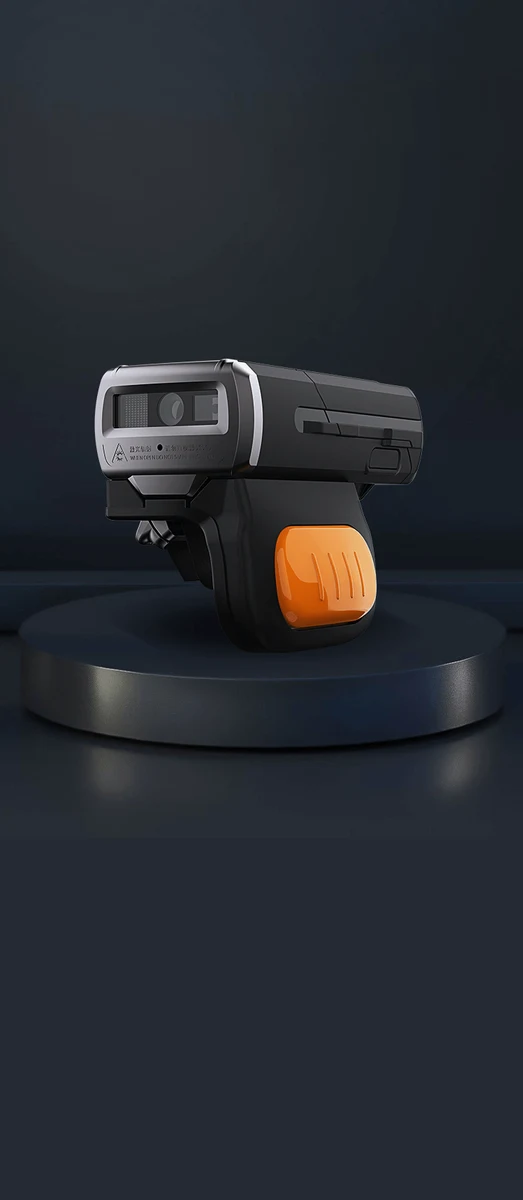
UROVO SR5600 is a wearable 1D/2D ring scanner designed for hands-busy picking, sorting and line-side work. The official page lists dual-mode Bluetooth, fast pairing methods, a removable 800 mAh battery, IP65 protection and finger or glove wear. Scan success and shift performance depend on the host device, code set and wearing configuration.
Suggested profiles: hands-free barcode capture for picking, sorting, replenishment and line-side work
- Scan engine
- Megapixel laser-aiming scan engine; 1D/2D, damaged, distorted and screen-code capture are described by the manufacturer
- Battery
- Removable lithium battery, 800 mAh
- Protection
- IP65
- Bluetooth
- Dual-mode Bluetooth supporting BLE and classic Bluetooth
- Product type
- Wearable 1D/2D ring scanner
- Pairing
- Default Bluetooth-list, code-scanning and NFC connection modes are listed
The exact model, regional configuration and commercial terms require project confirmation.
Browse by device capability
SR5600 / Browse by device capability
UROVO is the primary established product resource, with SEUIC (Dongji) and selected platforms used where the capture method, form factor or deployment requirement needs another option. Published models follow an evidence, regional-configuration and RuggedLayer validation path.
Suggested profiles
- Pick-and-pack and sortation workflows
- Replenishment and line-side barcode capture
- Hands-busy operations where a handheld scanner slows task movement
Browse by device capability
- A wearable scanner keeps both hands available for picking, sorting and replenishment tasks.
- Dual-mode Bluetooth supports BLE and classic Bluetooth host patterns.
- Multiple pairing methods can be evaluated against the host enrollment and operator handover process.
- A removable 800 mAh battery and IP65 protection support a defined shift and work-cell plan.
How a device enters the portfolio
Key specifications
Manufacturer-listed configuration; confirm the exact variant before ordering.
Data capture
| Scan engine | Megapixel laser-aiming scan engine; 1D/2D, damaged, distorted and screen-code capture are described by the manufacturer |
|---|
Connectivity
| Bluetooth | Dual-mode Bluetooth supporting BLE and classic Bluetooth |
|---|
Power and physical
| Battery | Removable lithium battery, 800 mAh |
|---|
Environmental
| Protection | IP65 |
|---|
Other configuration
| Product type | Wearable 1D/2D ring scanner |
|---|---|
| Pairing | Default Bluetooth-list, code-scanning and NFC connection modes are listed |
| Continuous work reference | About 4 hours of uninterrupted work is a manufacturer statement, not a RuggedLayer test result |
| Standby reference | More than 24 hours is a manufacturer statement, subject to host and configuration |
| Wearing method | Finger wear and glove wear are supported according to the manufacturer page |
| Accessories | Multiple accessory options are listed; ring, strap, battery and charger combination requires project selection |
A final shortlist depends on the application, scan or RFID workload, operating environment, country, deployment volume and support expectations.
A clear handoff at every layer
Five service layers for a more predictable device program.
RuggedLayer organizes access to multiple manufacturers into a consistent engagement model. Each layer has a defined input, deliverable and evidence boundary.
Service layers
- Select the host mobile computer, Bluetooth mode, pairing method, trigger behavior and feedback model before a pilot.
- Test finger and glove wearing, dominant-hand position, scan angle, operator fatigue, hygiene and shift handover.
- Treat the 4-hour work and 24-hour standby figures as manufacturer references; scan rate, pairing state and host radio policy affect runtime.
Deployment accessories
- Scope the ring or glove mount, spare battery, charger, host device, protective parts and a shift-change charging process.
- Keep the pairing procedure, host profile and operator fitting instructions with the deployment handover.
RuggedLayer Test Lab
Define a useful test, not a vague benchmark.
Tell us the labels, tags, application and operating conditions that matter.
- 01
Test the target 1D/2D code set, damaged labels and screen codes with the exact host and Bluetooth mode.
- 02
Repeat reads across distance, angle, lighting, glove type and task motion while recording pairing and host latency.
- 03
Measure battery runtime, charge rotation, fitting, hygiene and exception recovery over a representative shift.
Project intake
SR5600 / Start with enough context to make the next step useful.
Choose the closest project intent and describe only non-confidential workflow, application and deployment requirements.