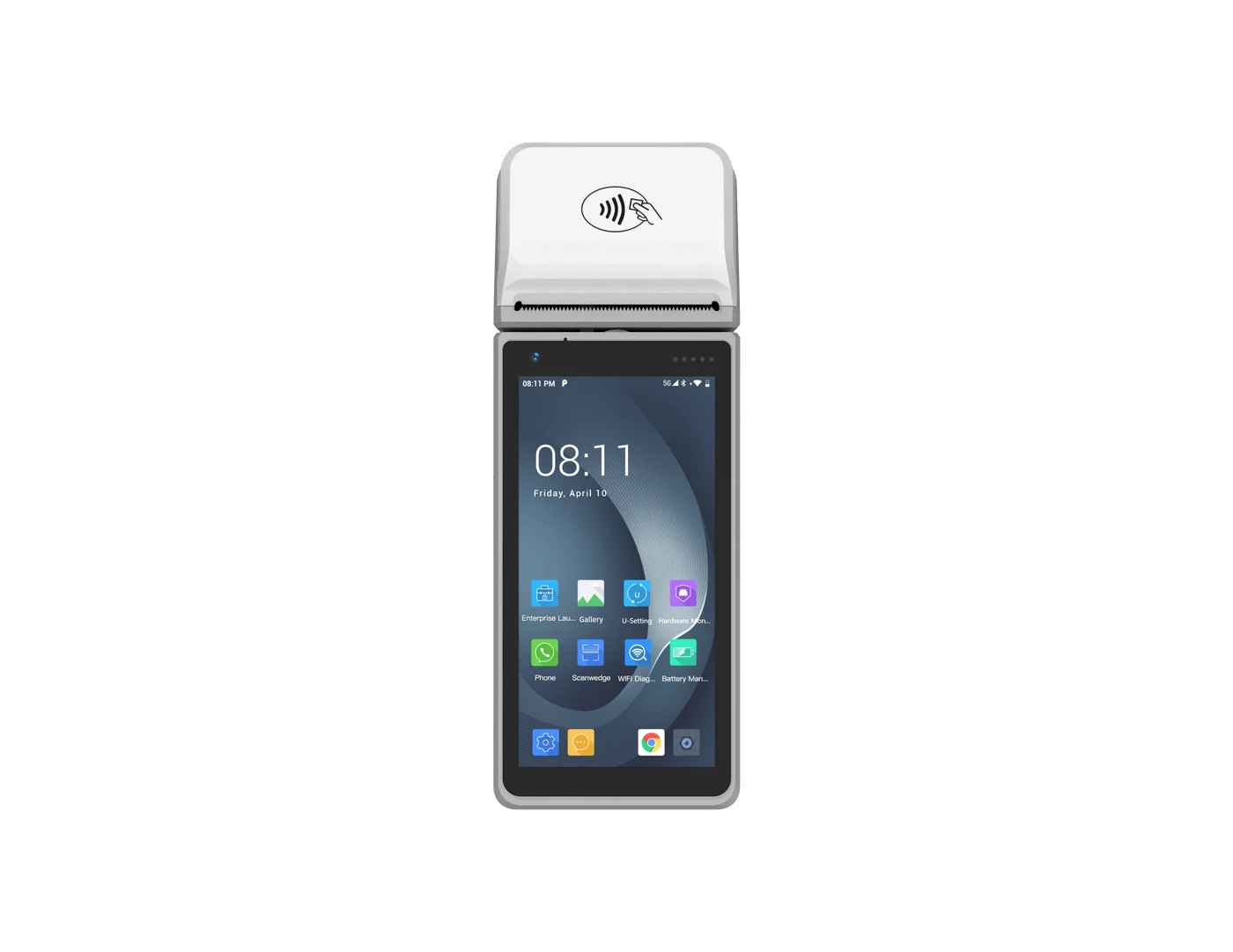
UROVO / Payment terminals
i9200: Payment terminals
UROVO i9200 is a handheld Android payment terminal with an integrated receipt printer, card interfaces, payment QR capture and barcode-scanning options. The official page lists Android 13, a 5.5 inch display, removable 5000 mAh power and 58 mm printing. Payment acceptance is an acquiring and application decision, not a blanket claim made by this product page.
Suggested profiles: retail checkout, assisted payment and field transaction workflows with a defined acquiring environment
- Processor
- Quad-core A53 2.0 GHz; optional octa-core A53 2.0 GHz
- Memory
- 2 GB RAM / 16 GB ROM; optional 3 GB RAM / 32 GB ROM; Micro SD/TF up to 128 GB
- Display
- 5.5 inch display, 720 x 1440
- Scanning
- Camera decoding for barcodes and payment QR codes; optional scan engine
- Battery
- Removable lithium-polymer battery, 3.85 V / 5000 mAh
- Dimensions and weight
- 213.6 x 79 x 48.8 mm, 18.5 mm thinnest section; 363 g
The exact model, regional configuration and commercial terms require project confirmation.
Browse by device capability
i9200 / Browse by device capability
UROVO is the primary established product resource, with SEUIC (Dongji) and selected platforms used where the capture method, form factor or deployment requirement needs another option. Published models follow an evidence, regional-configuration and RuggedLayer validation path.
Suggested profiles
- Retail and service-counter assisted checkout
- Mobile or queue-side transactions with printed receipts
- Payment pilots where the acquirer and software stack are already defined
Browse by device capability
- A handheld payment form factor combines transaction interfaces, QR capture, barcode options and receipt printing.
- Android 13 and 2/16 GB or optional 3/32 GB configurations are listed by the manufacturer.
- The integrated 58 mm printer supports a defined mobile receipt workflow.
- Payment acceptance must be validated with the target acquirer, application, country and security configuration.
How a device enters the portfolio
Key specifications
Manufacturer-listed configuration; confirm the exact variant before ordering.
Platform
| Processor | Quad-core A53 2.0 GHz; optional octa-core A53 2.0 GHz |
|---|---|
| Operating system | Android 13 |
| Memory | 2 GB RAM / 16 GB ROM; optional 3 GB RAM / 32 GB ROM; Micro SD/TF up to 128 GB |
| Display | 5.5 inch display, 720 x 1440 |
| Positioning | GPS, A-GPS, BeiDou, GLONASS and Galileo listed |
Data capture
| Scanning | Camera decoding for barcodes and payment QR codes; optional scan engine |
|---|---|
| Camera | No front camera or optional 2 MP fixed-focus camera; rear 5 MP autofocus or optional 16 MP autofocus |
Power and physical
| Payment interfaces | Magnetic-stripe card, IC card and contactless card interfaces are listed; approval and scheme support are configuration- and market-dependent |
|---|---|
| Battery | Removable lithium-polymer battery, 3.85 V / 5000 mAh |
| Interfaces | USB Type-C OTG and 5-pin pogo interface |
| Dimensions and weight | 213.6 x 79 x 48.8 mm, 18.5 mm thinnest section; 363 g |
Environmental
| Environmental | Operating 0 to +50 C; storage -20 to +70 C; 5-95% RH non-condensing |
|---|
Other configuration
| Printer | 58 mm paper, 203 dpi, 60-80 mm/s listed; media roll diameter up to 40 mm |
|---|
A final shortlist depends on the application, scan or RFID workload, operating environment, country, deployment volume and support expectations.
A clear handoff at every layer
Five service layers for a more predictable device program.
RuggedLayer organizes access to multiple manufacturers into a consistent engagement model. Each layer has a defined input, deliverable and evidence boundary.
Service layers
- Separate standard financial and non-financial use cases and confirm the security, card, QR, printer and camera options in the ordered SKU.
- Do not infer PCI, EMV, contactless scheme, acquirer or country approval from the device feature list; the payment application owner must confirm the required process.
- Test receipt media, print templates, QR capture, transaction recovery, network behavior, battery rotation and secure application enrollment.
Deployment accessories
- Scope the approved charger, cradle or counter stand, receipt media, protective carry equipment and any payment-specific peripherals.
- Keep the application, key-injection, acquirer, receipt and device-enrollment responsibilities explicit in the project handover.
RuggedLayer Test Lab
Define a useful test, not a vague benchmark.
Tell us the labels, tags, application and operating conditions that matter.
- 01
Run the target payment application and acquiring flow on the exact processor, memory, security and communication configuration.
- 02
Test magnetic-stripe, IC, contactless, payment QR, barcode and receipt paths only where the ordered configuration and application support them.
- 03
Verify transaction timeout, offline policy, reboot recovery, key protection, printer recovery and support ownership before acceptance.
Project intake
i9200 / Start with enough context to make the next step useful.
Choose the closest project intent and describe only non-confidential workflow, application and deployment requirements.