UROVO / Handheld RFID readers
DT50U: Handheld RFID readers
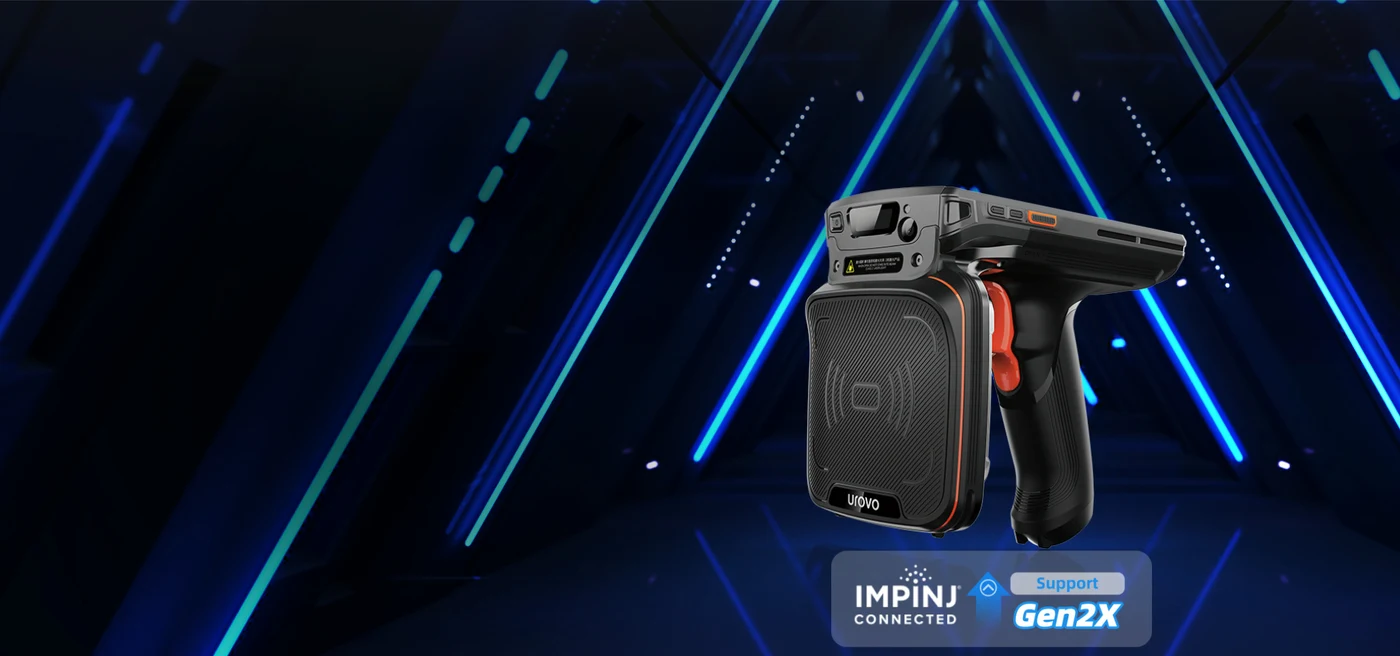
UROVO DT50U is a rugged handheld UHF RFID reader that combines long-range tag capture with 1D/2D barcode scanning for inventory and asset workflows. Official UROVO materials list an Impinj E710 RFID platform, a 5 dBi internal antenna, SJC interference cancellation, a 9000 mAh battery and IP67 protection. The published range and throughput figures are manufacturer lab references and must be validated with the target tags and environment.
Suggested profiles: mobile UHF RFID inventory, asset tracking and barcode exception workflows
- Processor
- Octa-core 64-bit processor; 2.45 GHz is listed on the official Chinese specification, while the English page lists 2.0 GHz. Confirm the exact SKU.
- Memory
- 3 GB RAM / 32 GB ROM or 4 GB RAM / 64 GB ROM options are listed; expansion limit differs across source versions and requires SKU confirmation
- Display
- 5.7 inch color display, 720 x 1440
- RFID platform
- Impinj E710 with internal 5 dBi high-sensitivity antenna; SJC interference cancellation is described by the manufacturer
- Battery
- Replaceable 3.85 V, 9000 mAh battery
- Protection
- IP67; multiple 1.5 m drops to concrete at room temperature listed
The exact model, regional configuration and commercial terms require project confirmation.
Browse by device capability
DT50U / Browse by device capability
UROVO is the primary established product resource, with SEUIC (Dongji) and selected platforms used where the capture method, form factor or deployment requirement needs another option. Published models follow an evidence, regional-configuration and RuggedLayer validation path.
Suggested profiles
- Cycle counts and warehouse stock reconciliation
- Asset, tool, apparel and jewelry inventory audits
- Receiving and returns workflows that need RFID with barcode fallback
Browse by device capability
- A handle-style handheld for RFID inventory, asset and exception workflows.
- The manufacturer names an Impinj E710 platform, 5 dBi internal antenna and SJC interference cancellation.
- Barcode capture provides a fallback or companion workflow when RFID is not available on an item.
- The 9000 mAh replaceable battery and IP67 protection support long shifts, subject to the final configuration and workload.
How a device enters the portfolio
Key specifications
Manufacturer-listed configuration; confirm the exact variant before ordering.
Platform
| Processor | Octa-core 64-bit processor; 2.45 GHz is listed on the official Chinese specification, while the English page lists 2.0 GHz. Confirm the exact SKU. |
|---|---|
| Operating system | Android |
| Memory | 3 GB RAM / 32 GB ROM or 4 GB RAM / 64 GB ROM options are listed; expansion limit differs across source versions and requires SKU confirmation |
| Display | 5.7 inch color display, 720 x 1440 |
| SIM and storage | Two Nano-SIM slots and Micro SD support listed; exact expansion limit requires SKU confirmation |
Data capture
| RFID platform | Impinj E710 with internal 5 dBi high-sensitivity antenna; SJC interference cancellation is described by the manufacturer |
|---|---|
| RFID performance reference | Up to 20 m and 1000 tags per second in official lab references; another English feature block states 15 m. Not a RuggedLayer test result |
| Barcode scanning | Mainstream 1D/2D and screen barcode capture listed |
| Camera | Front 5 MP; top or rear 13 MP autofocus camera with flash listed |
Connectivity
| Wireless | 4G/3G/2G, dual-band 2.4/5 GHz Wi-Fi and Bluetooth 5.0 with BR/EDR/BLE listed; bands require regional confirmation |
|---|
Power and physical
| Battery | Replaceable 3.85 V, 9000 mAh battery |
|---|---|
| Dimensions and weight | 143.3 x 169 x 90.5 mm; 678 g |
Environmental
| Protection | IP67; multiple 1.5 m drops to concrete at room temperature listed |
|---|---|
| Environmental | Operating -20 to +60 C; storage -40 to +70 C; 5-95% RH non-condensing; ESD +/-15 kV air and +/-8 kV contact listed |
A final shortlist depends on the application, scan or RFID workload, operating environment, country, deployment volume and support expectations.
A clear handoff at every layer
Five service layers for a more predictable device program.
RuggedLayer organizes access to multiple manufacturers into a consistent engagement model. Each layer has a defined input, deliverable and evidence boundary.
Service layers
- Confirm the exact processor, memory, radio, scanner and storage configuration; do not merge conflicting source-version values into one SKU promise.
- Treat the 20 m, 15 m and 1000 tags-per-second figures as manufacturer references; tag material, orientation, density, power and interference determine field performance.
- Plan the trigger, grip, battery rotation, RFID SDK or integration path, regional RF settings and offline recovery around the count route.
Deployment accessories
- Plan a single or multi-device charging arrangement, spare batteries, hand strap, protective case and pistol-grip workflow where required.
- Use representative tags, fixtures and shielding materials during the pilot instead of relying on a generic range assumption.
RuggedLayer Test Lab
Define a useful test, not a vague benchmark.
Tell us the labels, tags, application and operating conditions that matter.
- 01
Test the target tag IC, material, orientation, density and barcode fallback at the required read boundary.
- 02
Record missed, duplicate, stray and shielded reads across repeated sessions with the production application and final RF configuration.
- 03
Measure battery rotation, charging, Wi-Fi/WWAN recovery, scan feedback and operator ergonomics before approving the rollout.
Project intake
DT50U / Start with enough context to make the next step useful.
Choose the closest project intent and describe only non-confidential workflow, application and deployment requirements.