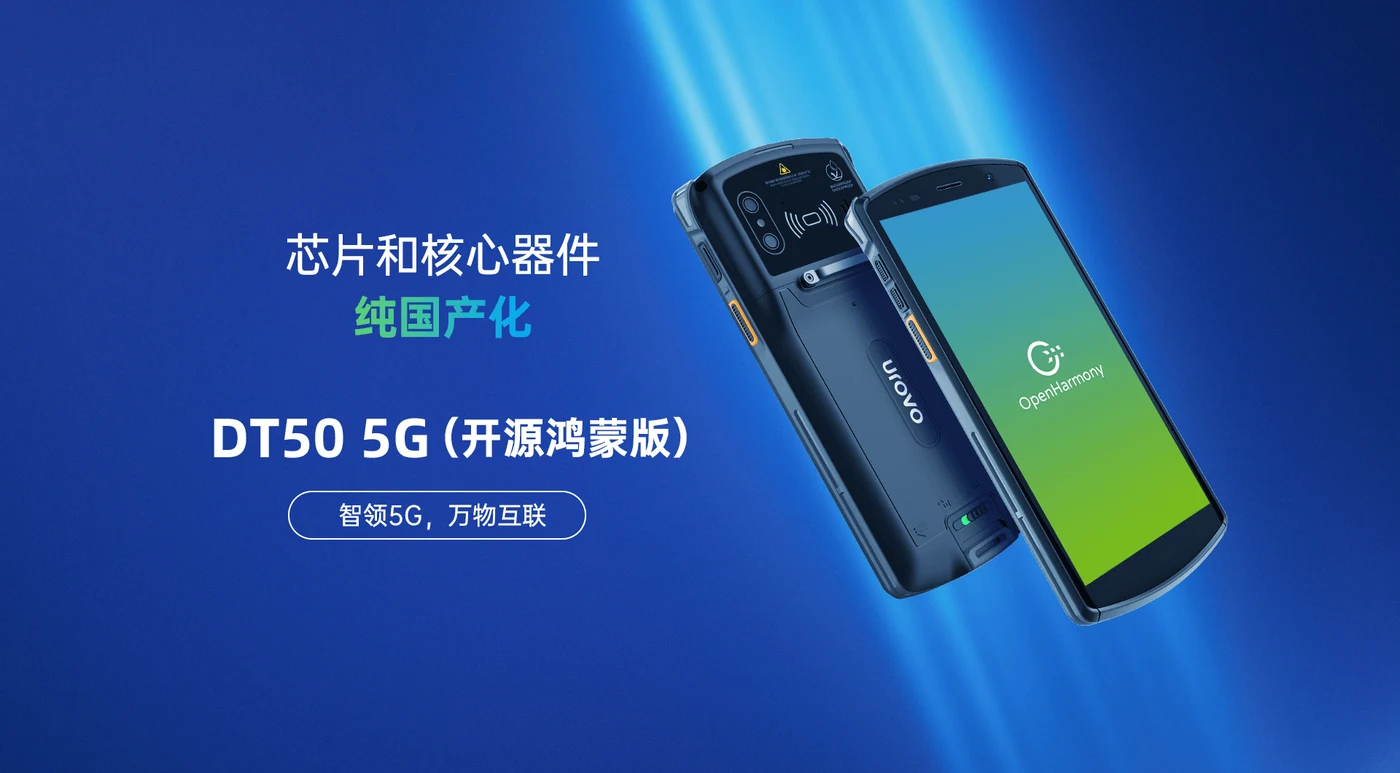
UROVO / Enterprise mobile computers
DT50 5G OpenHarmony: Enterprise mobile computers
UROVO DT50 5G OpenHarmony is a 5G rugged handheld variant for projects that require OpenHarmony 4.1 rather than an Android software image. The official Chinese page lists 1D/2D capture, removable 5000 mAh power, 5G/4G/3G/2G connectivity and IP67 protection; application compatibility must be validated against the OpenHarmony SDK and target build.
Suggested profiles: OpenHarmony mobile data capture, logistics and field-service applications
- Operating system
- OpenHarmony 4.1
- Memory
- 4 GB RAM / 64 GB ROM; optional 8 GB RAM / 128 GB ROM; Micro SD expansion up to 256 GB
- Display
- 5.7 inch touch display, 720 x 1440
- Scanning
- Professional scan engine for listed mainstream 1D/2D barcodes and screen codes
- Battery
- Removable 3.85 V, 5000 mAh battery
- Protection
- IP67; 1.5 m drop resistance listed
The exact model, regional configuration and commercial terms require project confirmation.
Browse by device capability
DT50 5G OpenHarmony / Browse by device capability
UROVO is the primary established product resource, with SEUIC (Dongji) and selected platforms used where the capture method, form factor or deployment requirement needs another option. Published models follow an evidence, regional-configuration and RuggedLayer validation path.
Suggested profiles
- OpenHarmony application programs with a defined SDK and device-management path
- Logistics and field workflows requiring 5G mobile data and barcode capture
- Controlled pilots where software image compatibility is a primary selection factor
Browse by device capability
- A distinct OpenHarmony 4.1 software baseline for a controlled application program.
- The manufacturer lists 5G radio, 1D/2D and screen-code capture, NFC and dual-band Wi-Fi.
- Optional memory and camera configurations allow the project to match application needs.
- IP67 protection and a 1.5 m drop specification are manufacturer-listed references.
How a device enters the portfolio
Key specifications
Manufacturer-listed configuration; confirm the exact variant before ordering.
Platform
| Operating system | OpenHarmony 4.1 |
|---|---|
| Processor | 8-core 2.7 GHz CPU listed by the manufacturer |
| Memory | 4 GB RAM / 64 GB ROM; optional 8 GB RAM / 128 GB ROM; Micro SD expansion up to 256 GB |
| Display | 5.7 inch touch display, 720 x 1440 |
Data capture
| Scanning | Professional scan engine for listed mainstream 1D/2D barcodes and screen codes |
|---|---|
| Camera | 5 MP front / 13 MP rear standard option; 8 MP front / 16 MP rear option listed |
| NFC | ISO15693, ISO14443A/B, Mifare and Felica support listed |
Connectivity
| Wireless | 5G/4G/3G/2G, dual-band 2.4/5 GHz Wi-Fi and Bluetooth 5.0 |
|---|---|
| SIM | One Nano-SIM slot listed; Micro SD option requires confirmation |
Power and physical
| Battery | Removable 3.85 V, 5000 mAh battery |
|---|---|
| Dimensions and weight | 162.6 x 76 x 13.6 mm; 265 g |
Environmental
| Protection | IP67; 1.5 m drop resistance listed |
|---|---|
| Environmental | Operating -20 to +60 C; confirm storage and humidity limits for the ordered configuration |
A final shortlist depends on the application, scan or RFID workload, operating environment, country, deployment volume and support expectations.
A clear handoff at every layer
Five service layers for a more predictable device program.
RuggedLayer organizes access to multiple manufacturers into a consistent engagement model. Each layer has a defined input, deliverable and evidence boundary.
Service layers
- Do not assume Android APK, GMS, Android Enterprise or Android MDM compatibility; validate the OpenHarmony application path first.
- Confirm the Chinese-source variant, target radio bands, SIM arrangement, update policy and software support owner.
- Keep optional memory, camera, scanner and accessory selections in the project configuration record.
Deployment accessories
- Scope the adapter, cable, removable battery, single or multi-device charger, wrist strap and screen protection listed by the manufacturer.
- Confirm that charging and device-management accessories support the selected OpenHarmony deployment process.
RuggedLayer Test Lab
Define a useful test, not a vague benchmark.
Tell us the labels, tags, application and operating conditions that matter.
- 01
Build and run the target application on OpenHarmony 4.1 with the exact SDK, firmware and device-management configuration.
- 02
Test barcode, screen-code, NFC, Wi-Fi and 5G behavior using the project acceptance cases.
- 03
Verify update, logging, offline recovery, battery rotation and regional radio behavior before approving a pilot.
Project intake
DT50 5G OpenHarmony / Start with enough context to make the next step useful.
Choose the closest project intent and describe only non-confidential workflow, application and deployment requirements.