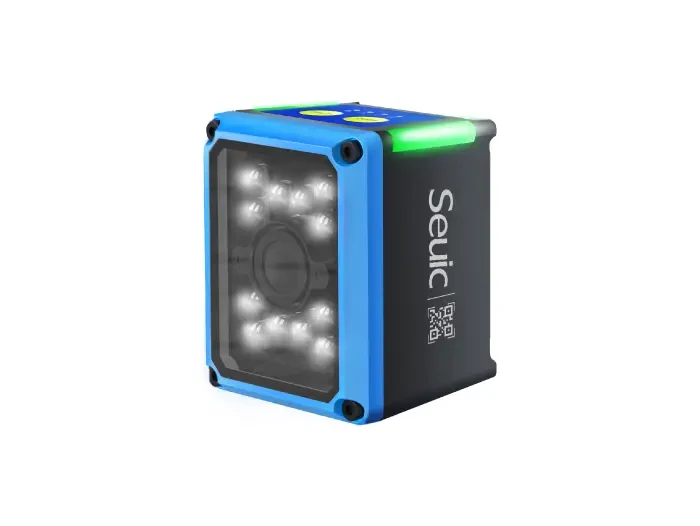
SEUIC (Dongji) / Industrial vision fixed readers
X5: Industrial vision fixed readers
SEUIC (Dongji) X5 is an AI industrial vision fixed reader for difficult code capture on defined production lines. The official English page lists a 2.0 MP reader, automatic parameter optimization, one-second on-site deployment and references for blurry, distorted, low-contrast and small laser-etched QR codes; the exact station configuration needs a line pilot.
Suggested profiles: fixed code-reading stations in electronics, semiconductor, new-energy, automotive and food manufacturing
- Product type
- Industrial vision fixed reader
- Resolution
- 2.0 MP, described by the manufacturer as a stage smart code reader
- Processing
- Next-generation AI chip and decoding algorithms
- Parameter setup
- Fully automatic parameter optimization is stated by the manufacturer
- Deployment reference
- On-site deployment in 1 second is a manufacturer reference, not a RuggedLayer acceptance result
- Code conditions
- Blur, distortion, low contrast and other challenging code conditions are described
The exact model, regional configuration and commercial terms require project confirmation.
Browse by device capability
X5 / Browse by device capability
UROVO is the primary established product resource, with SEUIC (Dongji) and selected platforms used where the capture method, form factor or deployment requirement needs another option. Published models follow an evidence, regional-configuration and RuggedLayer validation path.
Suggested profiles
- Electronics and semiconductor traceability stations
- Automotive and new-energy production-line code capture
- Fixed inspection or identification points with repeatable code geometry
Browse by device capability
- A fixed reader format suits repeatable machine-vision stations where the mark, distance and lighting can be controlled.
- AI decoding and automatic parameter optimization target difficult code conditions without assuming a universal read result.
- The manufacturer references 0.6 mm laser-etched QR codes on LCD panels; mark quality, optics, distance and line speed still determine actual performance.
- The listed industry fit covers electronics, semiconductor, new-energy, automotive and food manufacturing use cases.
How a device enters the portfolio
Key specifications
Manufacturer-listed configuration; confirm the exact variant before ordering.
Platform
| Parameter setup | Fully automatic parameter optimization is stated by the manufacturer |
|---|
Other configuration
| Product type | Industrial vision fixed reader |
|---|---|
| Resolution | 2.0 MP, described by the manufacturer as a stage smart code reader |
| Processing | Next-generation AI chip and decoding algorithms |
| Deployment reference | On-site deployment in 1 second is a manufacturer reference, not a RuggedLayer acceptance result |
| Code conditions | Blur, distortion, low contrast and other challenging code conditions are described |
| Small-code reference | Laser-etched QR codes as small as 0.6 mm on LCD panels are referenced by the manufacturer |
| Target industries | 3C electronics, semiconductors, new energy, automotive manufacturing and food and beverage |
A final shortlist depends on the application, scan or RFID workload, operating environment, country, deployment volume and support expectations.
A clear handoff at every layer
Five service layers for a more predictable device program.
RuggedLayer organizes access to multiple manufacturers into a consistent engagement model. Each layer has a defined input, deliverable and evidence boundary.
Service layers
- Treat the one-second deployment and small-code statements as manufacturer references; test the exact code, surface, distance, angle, lighting and line speed.
- Confirm the X5 lens, lighting, focus, trigger, I/O, host protocol, mounting and power wiring against the machine design.
- Define failure handling, result format, network segmentation, operator access and maintenance access before the production pilot.
Deployment accessories
- Scope the power supply, mounting hardware, network or machine cabling, trigger wiring and protective enclosure for the station.
- Keep the approved lens, lighting, code samples, focus settings and host protocol with the line handover record.
RuggedLayer Test Lab
Define a useful test, not a vague benchmark.
Tell us the labels, tags, application and operating conditions that matter.
- 01
Run representative blurry, distorted, low-contrast, reflective and laser-etched codes at the production distance and line speed.
- 02
Verify trigger timing, image/result handoff, host protocol, I/O levels, network recovery and fault behavior with the target controller.
- 03
Freeze the exact reader, optics, lighting, focus, firmware, power, wiring, protocol and acceptance thresholds before rollout.
Project intake
X5 / Start with enough context to make the next step useful.
Choose the closest project intent and describe only non-confidential workflow, application and deployment requirements.