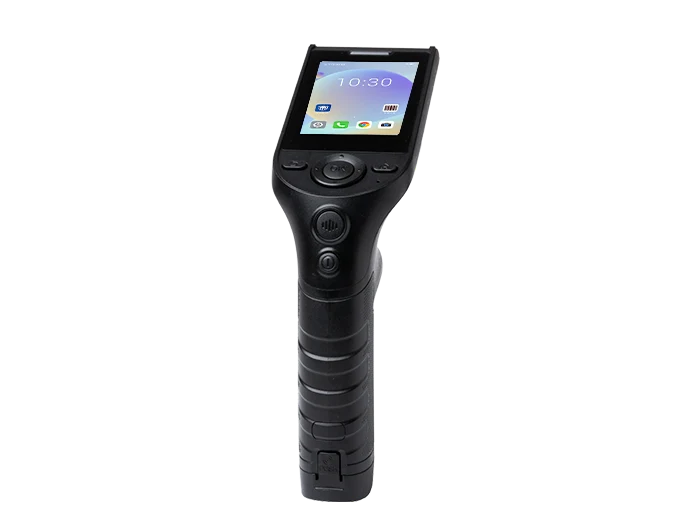
SEUIC (Dongji) / Keypad mobile terminals
Lim: Keypad mobile terminals
SEUIC (Dongji) Lim is a compact pistol-grip Android handheld for sorting, warehouse and retail scanning. The official page lists a 2.4 inch display, 2 GB RAM and 16 GB storage, a 3180 mAh removable battery, physical scan controls, 2D capture and IP54 protection. Its older software platform should be assessed before a new deployment.
Suggested profiles: sorting, warehouse, retail checkout and compact scan workflows
- Operating system
- Android 8.1 Go
- Memory
- 2 GB RAM / 16 GB storage
- Display
- 2.4 inch display, 320 x 240 pixels
- Scanning
- SEUIC 2D image scan engine
- Battery
- Detachable 3.7 V, 3180 mAh Li-ion battery; Micro USB charging
- Dimensions
- 159 x 54 x 114 mm; 22.2 mm thickness at the screen area
The exact model, regional configuration and commercial terms require project confirmation.
Browse by device capability
Lim / Browse by device capability
UROVO is the primary established product resource, with SEUIC (Dongji) and selected platforms used where the capture method, form factor or deployment requirement needs another option. Published models follow an evidence, regional-configuration and RuggedLayer validation path.
Suggested profiles
- Sorting and compact warehouse stations
- Retail checkout or backroom scanning
- Existing applications with a validated older Android baseline
Browse by device capability
- Compact pistol-grip form factor for short, repetitive scan interactions.
- Physical left and right scan controls reduce dependence on a full touch keyboard.
- The 2D image engine, removable battery and USB/OTG interface support defined legacy workflows.
- Android 8.1 Go is an important lifecycle constraint for new application and security planning.
How a device enters the portfolio
Key specifications
Manufacturer-listed configuration; confirm the exact variant before ordering.
Platform
| Operating system | Android 8.1 Go |
|---|---|
| Processor | Quad-core, 1.3 GHz |
| Memory | 2 GB RAM / 16 GB storage |
| Display | 2.4 inch display, 320 x 240 pixels |
Data capture
| Scanning | SEUIC 2D image scan engine |
|---|---|
| Sensor | Gyroscope listed |
Power and physical
| Dimensions | 159 x 54 x 114 mm; 22.2 mm thickness at the screen area |
|---|---|
| Weight | 220 g |
| Battery | Detachable 3.7 V, 3180 mAh Li-ion battery; Micro USB charging |
Environmental
| Environment | Operating -20 to +50 C; storage limits are battery dependent; 5-95% RH non-condensing |
|---|
Other configuration
| Controls | Volume, power, left and right scan, custom and virtual on-screen buttons |
|---|---|
| Expansion | No expansion slot listed |
| Connectivity | USB 2.0 and OTG; 2.4/5 GHz 802.11 a/b/g/n WLAN listed |
| Durability | IP54; manufacturer lists 1.8 m drops and 1000 tumbles at 0.5 m |
| Accessories | Power adapter, USB cable and single-device charging cradle listed |
A final shortlist depends on the application, scan or RFID workload, operating environment, country, deployment volume and support expectations.
A clear handoff at every layer
Five service layers for a more predictable device program.
RuggedLayer organizes access to multiple manufacturers into a consistent engagement model. Each layer has a defined input, deliverable and evidence boundary.
Service layers
- Confirm application compatibility, security support, MDM capability and software lifecycle before selecting this older platform.
- Test the small display, scan feedback, physical controls, WLAN behavior, battery charging and cradle workflow with operators.
- Verify the exact current SKU, accessory supply, destination channel rules and replacement plan before a new fleet purchase.
Deployment accessories
- Scope the single-device cradle, spare batteries, USB power, hand strap and operator carry arrangement.
- Keep the legacy application image and approved scan profile versioned with the device handover.
RuggedLayer Test Lab
Define a useful test, not a vague benchmark.
Tell us the labels, tags, application and operating conditions that matter.
- 01
Run the existing or target application on the exact Android image and validate input, permissions and offline behavior.
- 02
Test representative barcodes, screen codes, damaged labels, lighting, angle, distance and feedback modes.
- 03
Document security patch expectations, battery health, charging cycle, spare-unit plan and end-of-life triggers.
Project intake
Lim / Start with enough context to make the next step useful.
Choose the closest project intent and describe only non-confidential workflow, application and deployment requirements.