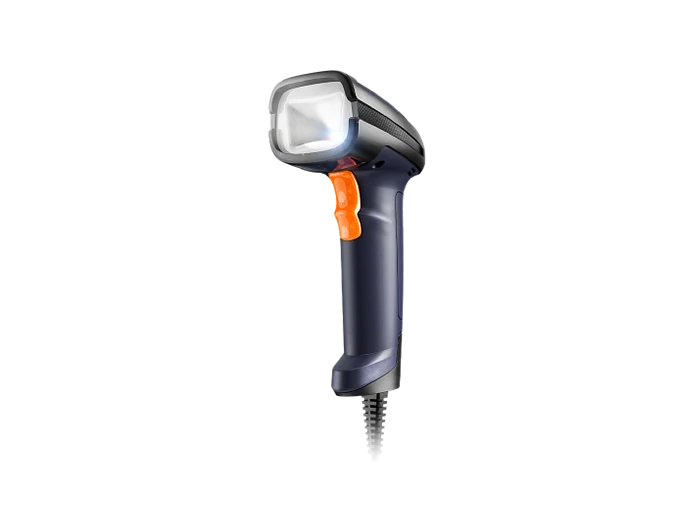
SEUIC (Dongji) / Barcode scanners
HS505 Series: Barcode scanners
SEUIC (Dongji) HS505 Series is a wired industrial barcode scanner for difficult direct-part marks and electronics traceability. The official page lists a 1280 x 1080 global-shutter sensor, adjustable red, white or blue diffuse lighting, DP and HDP options, USB or RS232 host modes and IP54 protection.
Suggested profiles: wired electronics, production, quality and workstation barcode capture
- Protection
- IP54; manufacturer lists 1.8 m drops and 0.5 m rolling impacts
- Image sensor
- 1280 x 1080 CMOS global-shutter sensor
- Lighting
- Adjustable diffuse red, white or blue lighting with laser cross aiming
- Capture rate
- Up to 60 frames per second
- Code support
- 1D Code 39, Code 128, Code 93, Codabar, UPC/EAN and I2of5; 2D QR, DataMatrix, PDF417 families; OCR customization is listed
- Resolution
- DP: 1D 2.5 mil / 2D 4 mil; HDP: 1D 2 mil / 2D 3 mil
The exact model, regional configuration and commercial terms require project confirmation.
Browse by device capability
HS505 Series / Browse by device capability
UROVO is the primary established product resource, with SEUIC (Dongji) and selected platforms used where the capture method, form factor or deployment requirement needs another option. Published models follow an evidence, regional-configuration and RuggedLayer validation path.
Suggested profiles
- Electronics and component traceability
- Production and quality inspection stations
- Parcel or workstation capture with a wired host
Browse by device capability
- A wired industrial scanner keeps host connectivity predictable at a production or workstation station.
- DP and HDP options, adjustable lighting and a global-shutter sensor target difficult direct marks.
- USB keyboard, USB COM and RS232 modes make the host integration contract explicit.
- DPM readability depends on mark quality, surface, angle, lighting and distance; it needs a representative pilot.
How a device enters the portfolio
Key specifications
Manufacturer-listed configuration; confirm the exact variant before ordering.
Platform
| Host interfaces | RS232, USB keyboard and USB COM |
|---|
Data capture
| Image sensor | 1280 x 1080 CMOS global-shutter sensor |
|---|
Power and physical
| Code support | 1D Code 39, Code 128, Code 93, Codabar, UPC/EAN and I2of5; 2D QR, DataMatrix, PDF417 families; OCR customization is listed |
|---|
Environmental
| Protection | IP54; manufacturer lists 1.8 m drops and 0.5 m rolling impacts |
|---|---|
| Environment | Operating 0 to +50 C; storage -20 to +70 C; 5-95% RH non-condensing |
Other configuration
| Lighting | Adjustable diffuse red, white or blue lighting with laser cross aiming |
|---|---|
| Capture rate | Up to 60 frames per second |
| Resolution | DP: 1D 2.5 mil / 2D 4 mil; HDP: 1D 2 mil / 2D 3 mil |
| Physical | 166.2 x 105.5 x 68.5 mm; approximately 165 g |
| Ambient light | 0-100,000 lux is listed by the manufacturer |
| Compliance listing | CE, FCC and RoHS are listed; verify the exact SKU and destination evidence |
A final shortlist depends on the application, scan or RFID workload, operating environment, country, deployment volume and support expectations.
A clear handoff at every layer
Five service layers for a more predictable device program.
RuggedLayer organizes access to multiple manufacturers into a consistent engagement model. Each layer has a defined input, deliverable and evidence boundary.
Service layers
- Choose DP or HDP optics, lighting, mount, cable, interface mode and trigger behavior for the target station.
- Test reflective, curved, perforated, low-contrast, damaged and laser-marked codes under production lighting.
- Confirm destination compliance documents, host drivers, power budget, reconnect behavior and maintenance access.
Deployment accessories
- Scope the stand or mount, USB or serial cable, power arrangement, lighting and replacement cable plan.
- Keep approved code samples, host profile, lighting settings and cleaning or service instructions with the handover.
RuggedLayer Test Lab
Define a useful test, not a vague benchmark.
Tell us the labels, tags, application and operating conditions that matter.
- 01
Measure reads, misses and duplicate events for the full target symbology and code-quality range.
- 02
Test USB and RS232 modes, trigger timing, host latency, lighting, mounting and application exception handling.
- 03
Record the selected optics, interface, firmware, mount, cable, compliance evidence and acceptance result.
Project intake
HS505 Series / Start with enough context to make the next step useful.
Choose the closest project intent and describe only non-confidential workflow, application and deployment requirements.