SEUIC (Dongji) / Barcode scanners
HS220C: Barcode scanners
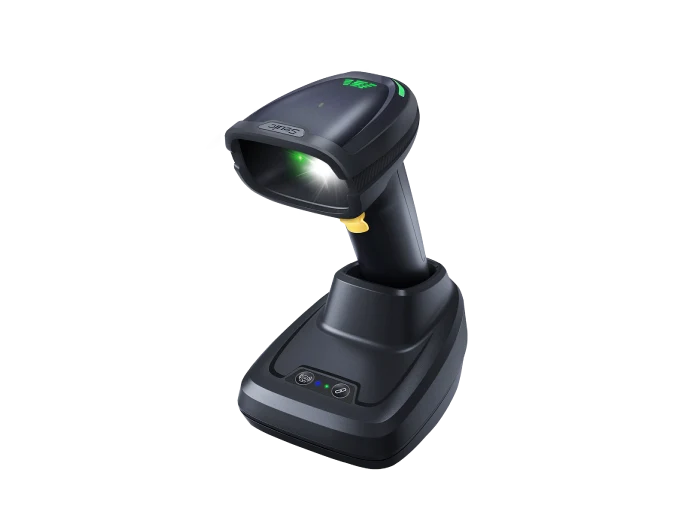
SEUIC (Dongji) HS220C is a wireless industrial barcode scanner for small, low-contrast and direct-marked codes. The official page lists a global-shutter 1280 x 1024 sensor, 60 fps capture, USB or RS-232 host modes, removable battery capacity information, IP54 protection and vibration feedback.
Suggested profiles: wireless production, retail, warehouse and difficult-code capture
- Battery
- 2150 mAh rated and 2600 mAh typical capacity listed; removable battery
- Protection
- IP54; manufacturer lists 50 drops from 1.5 m and 2000 tumbles at 0.5 m
- Dimensions
- 166.2 x 68.5 x 105.5 mm
- Image sensor
- 1280 x 1024 CMOS global-shutter sensor
- Camera options
- High-density and standard-range options listed
- Frame rate
- 60 fps
The exact model, regional configuration and commercial terms require project confirmation.
Browse by device capability
HS220C / Browse by device capability
UROVO is the primary established product resource, with SEUIC (Dongji) and selected platforms used where the capture method, form factor or deployment requirement needs another option. Published models follow an evidence, regional-configuration and RuggedLayer validation path.
Suggested profiles
- PCB, metal and DPM production codes
- Warehouse and retail stations requiring operator movement
- Quality and traceability checks with difficult code surfaces
Browse by device capability
- Wireless scanner format frees the operator from a fixed cable at production and warehouse stations.
- Global-shutter imaging and selectable illumination target small, low-contrast and marked codes.
- USB keyboard, USB COM and RS-232 host modes support different integration constraints.
- Battery, scan-count and radio figures are manufacturer references that need a shift and host pilot.
How a device enters the portfolio
Key specifications
Manufacturer-listed configuration; confirm the exact variant before ordering.
Platform
| Frame rate | 60 fps |
|---|---|
| Host interfaces | RS-232, USB keyboard and USB COM |
Data capture
| Image sensor | 1280 x 1024 CMOS global-shutter sensor |
|---|---|
| Camera options | High-density and standard-range options listed |
Power and physical
| Dimensions | 166.2 x 68.5 x 105.5 mm |
|---|---|
| Weight | About 200 g |
| Battery | 2150 mAh rated and 2600 mAh typical capacity listed; removable battery |
| Charge and usage | Manufacturer lists about 40,000 scans and 5-6 hours USB charge time |
Environmental
| Protection | IP54; manufacturer lists 50 drops from 1.5 m and 2000 tumbles at 0.5 m |
|---|---|
| Environment | Operating 0-50 C; storage -20 to +70 C; 5-95% RH non-condensing |
Other configuration
| Lighting and aimer | White illumination with green LED aiming |
|---|---|
| Decode scope | 1D and 2D families including UPC/EAN, Code 128, GS1-128, Code 39, Data Matrix, QR and PDF417 |
| Decode density | 1D codes to 3 mil; 2D codes to 5 mil listed |
| Ambient light | 0-100,000 lux listed |
| Feedback | Vibration motor, audible and visual feedback options are listed |
| Regulatory listing | CE, FCC, RoHS and UN38.3 are listed on the manufacturer page; verify exact SKU and destination evidence |
A final shortlist depends on the application, scan or RFID workload, operating environment, country, deployment volume and support expectations.
A clear handoff at every layer
Five service layers for a more predictable device program.
RuggedLayer organizes access to multiple manufacturers into a consistent engagement model. Each layer has a defined input, deliverable and evidence boundary.
Service layers
- Confirm wireless protocol, pairing mode, camera option, battery, interface and charging arrangement before ordering.
- Test marked, reflective, curved, damaged and low-contrast codes across the required angle, distance and lighting.
- Measure scan count, charge turnaround, roaming or reconnect, host latency and offline queue behavior over a representative shift.
Deployment accessories
- Scope the cradle or USB charging arrangement, stand, cable, spare battery, mount and operator carry equipment.
- Keep wireless pairing, host mode, scan profile and battery procedure versioned with the workstation deployment.
RuggedLayer Test Lab
Define a useful test, not a vague benchmark.
Tell us the labels, tags, application and operating conditions that matter.
- 01
Run the complete target code set and record first-pass, missed, duplicate and false-read behavior.
- 02
Test wireless range in the actual site, host reconnect, feedback, battery use and charge recovery.
- 03
Freeze the radio, optics, interface, firmware, accessories, compliance evidence and acceptance limits.
Project intake
HS220C / Start with enough context to make the next step useful.
Choose the closest project intent and describe only non-confidential workflow, application and deployment requirements.