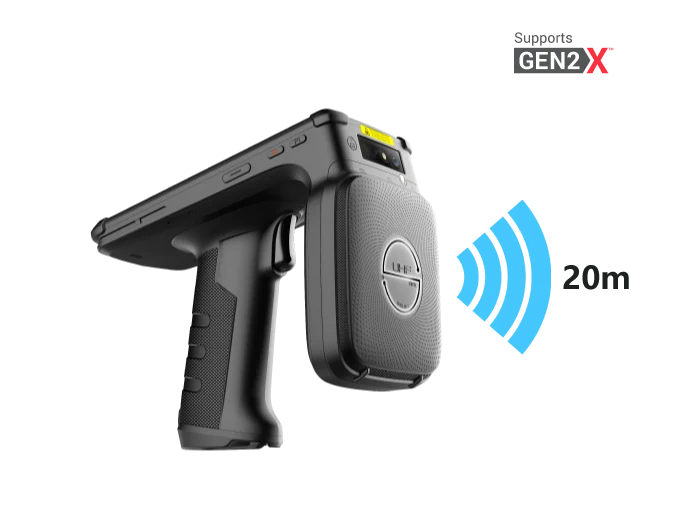
SEUIC (Dongji) / Handheld RFID readers
AUTOID UTouch 2-20: Handheld RFID readers
SEUIC (Dongji) AUTOID UTouch 2-20 is a pistol-grip Android handheld RFID reader for warehouse, asset and inventory work. The official page lists a 5.5 inch display, combined main and handle battery capacity of at least 11,700 mAh, UHF and HF/NFC functions, 2D scanning and IP67 protection.
Suggested profiles: mobile UHF and HF RFID inventory, asset and barcode workflows
- Operating system
- Android 14
- Memory
- 4 GB RAM / 64 GB flash; optional 6 GB / 64 GB or 8 GB / 128 GB
- Display
- 5.5 inch display, 1440 x 720 pixels, capacitive touch
- RFID performance
- Manufacturer lists 0-6 m writing with an 9662 white card and up to 1300 frames/s group reading under stated conditions
- Battery
- At least 11,700 mAh combined: 5000 mAh main unit plus replaceable 6700 mAh handle battery
- Dimensions
- 170 x 80 x 132.7 mm; 16.4 mm thickness at the main unit
The exact model, regional configuration and commercial terms require project confirmation.
Browse by device capability
AUTOID UTouch 2-20 / Browse by device capability
UROVO is the primary established product resource, with SEUIC (Dongji) and selected platforms used where the capture method, form factor or deployment requirement needs another option. Published models follow an evidence, regional-configuration and RuggedLayer validation path.
Suggested profiles
- Warehouse cycle counts and receiving
- Asset, tool and equipment audits
- Inventory workflows that need RFID with barcode fallback
Browse by device capability
- Combines UHF, HF/NFC and 2D barcode capture in a single pistol-grip workflow.
- The large combined battery capacity is suited to longer counting sessions when the handle SKU is confirmed.
- Regional UHF frequency and output fields are visible in the source data and must be locked before deployment.
- RFID range and group-reading figures are manufacturer references that depend on tags, materials and site geometry.
How a device enters the portfolio
Key specifications
Manufacturer-listed configuration; confirm the exact variant before ordering.
Platform
| Operating system | Android 14 |
|---|---|
| Processor | Octa-core, 2.0 GHz |
| Memory | 4 GB RAM / 64 GB flash; optional 6 GB / 64 GB or 8 GB / 128 GB |
| Display | 5.5 inch display, 1440 x 720 pixels, capacitive touch |
Data capture
| HF/NFC | ISO15693 and ISO14443A/B support; 13.56 MHz HF with typical short read distances listed by the manufacturer |
|---|---|
| RFID performance | Manufacturer lists 0-6 m writing with an 9662 white card and up to 1300 frames/s group reading under stated conditions |
| Scanning | Standard-range 2D imager scan engine |
| Camera | 5 MP fixed-focus front camera; 13 MP autofocus rear camera with PDAF and dual flash |
Power and physical
| Dimensions | 170 x 80 x 132.7 mm; 16.4 mm thickness at the main unit |
|---|---|
| Weight | 630 g with battery |
| Battery | At least 11,700 mAh combined: 5000 mAh main unit plus replaceable 6700 mAh handle battery |
Environmental
| Environment | Operating -20 to +50 C; storage -40 to +60 C with battery and -40 to +70 C without; 5-95% RH non-condensing |
|---|
Other configuration
| UHF protocol | Regional UHF reader configuration; page lists FHSS or fixed-frequency modes and a 5 dBi circular antenna |
|---|---|
| UHF frequency and output | Default 902-928 MHz antenna profile and 1-33 dBm output listed; confirm legal regional settings |
| Connectivity | USB Type-C, USB 2.0, OTG, fast charging, SIM plus TF slot and Type-C audio support |
| Durability | IP67; manufacturer lists multiple 2.0 m drops |
A final shortlist depends on the application, scan or RFID workload, operating environment, country, deployment volume and support expectations.
A clear handoff at every layer
Five service layers for a more predictable device program.
RuggedLayer organizes access to multiple manufacturers into a consistent engagement model. Each layer has a defined input, deliverable and evidence boundary.
Service layers
- Resolve the 2-20 model scope, handle battery, memory, UHF frequency, output, antenna and regional certification before order.
- Pilot UHF and HF tags across real materials, orientations, density, shelving and interference conditions.
- Define RFID event deduplication, barcode fallback, offline queueing, charging and operator carry procedures with the application owner.
Deployment accessories
- Scope replaceable handle batteries, charging cradle or USB-C power, protective equipment, strap and approved carry hardware.
- Keep regional RF settings, approved tags, reader configuration and application event mapping versioned for handover.
RuggedLayer Test Lab
Define a useful test, not a vague benchmark.
Tell us the labels, tags, application and operating conditions that matter.
- 01
Test UHF read/write and HF/NFC reads at the required boundary with representative tags and physical fixtures.
- 02
Measure duplicate suppression, scan-to-application latency, network recovery, battery use and charge turnaround.
- 03
Approve the exact RF profile, firmware, application behavior, battery set, accessories and site acceptance record.
Project intake
AUTOID UTouch 2-20 / Start with enough context to make the next step useful.
Choose the closest project intent and describe only non-confidential workflow, application and deployment requirements.