SEUIC (Dongji) / Handheld RFID readers
AUTOID UTouch 2-S6+3: Handheld RFID readers
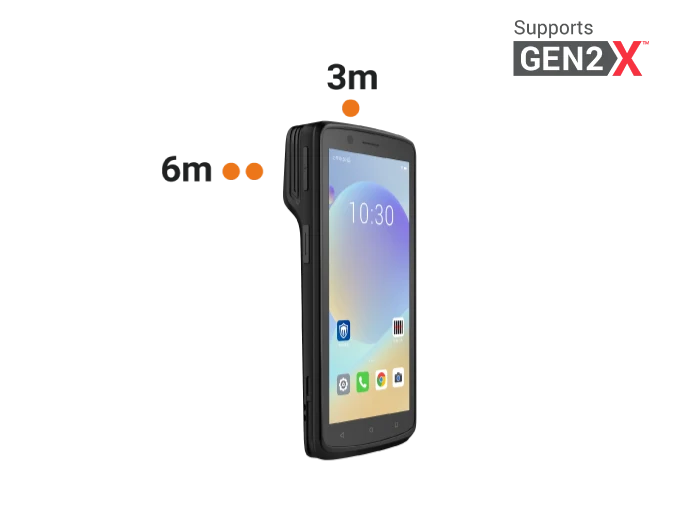
SEUIC (Dongji) AUTOID UTouch 2-S6+3 is a compact Android handheld RFID reader with front and back scan options for inventory, retail and asset workflows. The official page lists a 0-3 m front or 0-6 m standard reading reference, barcode and camera capture, a 5000 mAh battery and IP67 protection; tag and regional RF behavior require a pilot.
Suggested profiles: retail, asset, inventory and compact mobile RFID operations
- Operating system
- Android 11.0 or Android 14.0; the page lists a future-upgrade reference that requires confirmation
- Memory
- 4 GB RAM / 64 GB flash; optional 6 GB / 64 GB or 8 GB / 128 GB
- Display
- 5.5 inch capacitive display, 1440 x 720 pixels
- Barcode scanning
- Middle-range 2D imager scan engine
- Battery
- 5000 mAh with bottom Type-C USB and QC3.0 fast charging
- Wireless
- Dual-band 2.4/5 GHz Wi-Fi profile listed; WLAN and WWAN details require exact configuration confirmation
The exact model, regional configuration and commercial terms require project confirmation.
Browse by device capability
AUTOID UTouch 2-S6+3 / Browse by device capability
UROVO is the primary established product resource, with SEUIC (Dongji) and selected platforms used where the capture method, form factor or deployment requirement needs another option. Published models follow an evidence, regional-configuration and RuggedLayer validation path.
Suggested profiles
- Retail inventory and store operations
- Asset, cash-box and tool tracking
- Receiving, audit and exception workflows with mobile barcode and RFID capture
Browse by device capability
- Front and back RFID scan arrangements support compact item-level workflows with different read geometries.
- Barcode, camera and UHF capture combine common identification methods on one handheld.
- The manufacturer lists 0-3 m front and 0-6 m standard reading references; tag, orientation and site conditions determine actual range.
- The 902-928 MHz reference must be checked against the destination market before ordering.
How a device enters the portfolio
Key specifications
Manufacturer-listed configuration; confirm the exact variant before ordering.
Platform
| Operating system | Android 11.0 or Android 14.0; the page lists a future-upgrade reference that requires confirmation |
|---|---|
| Processor | Octa-core, 2.0 GHz |
| Memory | 4 GB RAM / 64 GB flash; optional 6 GB / 64 GB or 8 GB / 128 GB |
| Display | 5.5 inch capacitive display, 1440 x 720 pixels |
Data capture
| Barcode scanning | Middle-range 2D imager scan engine |
|---|---|
| Camera | 5 MP fixed-focus front camera; 13 MP autofocus rear camera with PDAF and dual flash |
Connectivity
| Wireless | Dual-band 2.4/5 GHz Wi-Fi profile listed; WLAN and WWAN details require exact configuration confirmation |
|---|
Power and physical
| Dimensions | 156 x 76 x 14 mm; 28.2 mm at the UHF antenna |
|---|---|
| Weight | 325 g with battery |
| Battery | 5000 mAh with bottom Type-C USB and QC3.0 fast charging |
Environmental
| Environment | Operating -20 to +50 C; storage -40 to +60 C with battery and -40 to +70 C without battery; 5-95% RH |
|---|
Other configuration
| Controls | Power, volume, two scan keys and custom key |
|---|---|
| UHF antenna | 0.5 dBi circular polarization; the page lists 902-928 MHz for the standard configuration |
| UHF radio | FHSS or fixed-frequency mode with 1-30 dBm output |
| UHF read reference | Back scan at least 6 m and front scan at least 3 m on a 9662 white card; tag and environment affect actual distance |
| UHF throughput | Up to 700 tags per second on Impinj H47 as a manufacturer reference |
| UHF write reference | 0-2 m on a 9662 white card as a manufacturer reference |
| Durability | IP67; multiple 1.8 m drops and +/-15 kV air / +/-8 kV direct ESD references listed |
| Accessories | Power adapter and Type-C cable standard; single cradle, quad battery charger, OTG cable and hand strap listed as additional options |
A final shortlist depends on the application, scan or RFID workload, operating environment, country, deployment volume and support expectations.
A clear handoff at every layer
Five service layers for a more predictable device program.
RuggedLayer organizes access to multiple manufacturers into a consistent engagement model. Each layer has a defined input, deliverable and evidence boundary.
Service layers
- Confirm the scan arrangement, Android image, memory, UHF region, reader profile and accessory set before quotation.
- Test front and back scan geometry with representative tags, materials, orientation, distance, density and motion.
- Resolve the Android lifecycle and MDM baseline; a future-upgrade reference is not a delivered software commitment.
Deployment accessories
- Plan single-device and battery charging, OTG cable, hand strap, protective parts and a shift-based spare-battery process.
- Keep the approved tag profile, antenna orientation and operator scan method with the deployment handover.
RuggedLayer Test Lab
Define a useful test, not a vague benchmark.
Tell us the labels, tags, application and operating conditions that matter.
- 01
Record read, write, miss, duplicate and stray events separately for front and back scan positions.
- 02
Run barcode and RFID tests with the production application, offline recovery, Wi-Fi roaming and battery charging.
- 03
Freeze UHF frequency, output, antenna, firmware, Android image, MDM policy, accessories and acceptance thresholds.
Project intake
AUTOID UTouch 2-S6+3 / Start with enough context to make the next step useful.
Choose the closest project intent and describe only non-confidential workflow, application and deployment requirements.