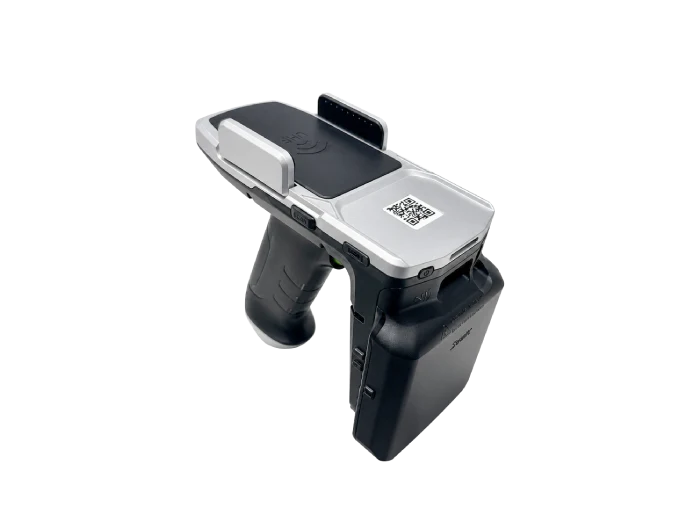
SEUIC (Dongji) / Handheld RFID readers
AUTOID UM3: Handheld RFID readers
SEUIC (Dongji) AUTOID UM3 is a gun-mounted UHF RFID reader that adds RFID capability to a compatible phone or handheld computer. The official page lists USB Type-C connection, a 4 dBi antenna, removable power, IP65 protection and manufacturer references above 10 m and 800 tags per second under stated conditions.
Suggested profiles: RFID expansion for compatible phones and handheld computers
- RFID protocols
- EPC C1 Gen2 / ISO18000-6C
- Battery
- 6400 mAh typical capacity, 6200 mAh rated capacity
- Protection
- IP65
- Host model
- Gun-mounted attachment for a companion device 60-80 mm wide
- Frequency
- 860-960 MHz, adjustable for country or regional requirements
- RF output
- 1-33 dBm adjustable in 1 dBm steps
The exact model, regional configuration and commercial terms require project confirmation.
Browse by device capability
AUTOID UM3 / Browse by device capability
UROVO is the primary established product resource, with SEUIC (Dongji) and selected platforms used where the capture method, form factor or deployment requirement needs another option. Published models follow an evidence, regional-configuration and RuggedLayer validation path.
Suggested profiles
- RFID add-on projects for existing handheld fleets
- Warehouse inventory and asset audits
- Pilot deployments where a separate integrated terminal is not required
Browse by device capability
- A companion-device attachment can extend an existing mobile workflow with UHF RFID capture.
- USB Type-C, adjustable output and a 4 dBi antenna keep the integration boundary explicit.
- The manufacturer range, tag-rate and endurance figures require target-device and target-tag validation.
- Host fit and mechanical retention are as important as RF performance for deployment reliability.
How a device enters the portfolio
Key specifications
Manufacturer-listed configuration; confirm the exact variant before ordering.
Platform
| Host model | Gun-mounted attachment for a companion device 60-80 mm wide |
|---|---|
| Operating time | 8-12 hours is listed by the manufacturer and depends on host, RF and workload |
Data capture
| RFID protocols | EPC C1 Gen2 / ISO18000-6C |
|---|
Power and physical
| Battery | 6400 mAh typical capacity, 6200 mAh rated capacity |
|---|
Environmental
| Protection | IP65 |
|---|---|
| Environment | Operating -20 to +46 C; storage -40 to +60 C |
Other configuration
| Frequency | 860-960 MHz, adjustable for country or regional requirements |
|---|---|
| RF output | 1-33 dBm adjustable in 1 dBm steps |
| Antenna | 4 dBi circular-polarized antenna |
| Performance reference | More than 10 m read distance and up to 800 tags/s with an Impinj H47 reference tag under stated conditions |
| Connection | USB Type-C; power and working-status indicators with buzzer |
| Physical | 169 x 90 x 145 mm; approximately 500 g |
A final shortlist depends on the application, scan or RFID workload, operating environment, country, deployment volume and support expectations.
A clear handoff at every layer
Five service layers for a more predictable device program.
RuggedLayer organizes access to multiple manufacturers into a consistent engagement model. Each layer has a defined input, deliverable and evidence boundary.
Service layers
- Confirm companion-device width, case clearance, USB behavior, mechanical retention and application SDK support.
- Set the regional UHF profile and test target tags, materials, density, operator motion and battery charging.
- Validate host power management, disconnect recovery, data ownership and ergonomics before a fleet rollout.
Deployment accessories
- Scope the compatible host, mounting or retention parts, spare batteries, USB-C cable and charging arrangement.
- Keep the host application version, RF profile, mechanical fit record and battery rotation process with the handover.
RuggedLayer Test Lab
Define a useful test, not a vague benchmark.
Tell us the labels, tags, application and operating conditions that matter.
- 01
Measure RFID read, write, missed and stray events with the selected host and representative tags.
- 02
Test USB connection, disconnect recovery, trigger handling, battery endurance, charging and application sync.
- 03
Freeze the host model, mechanical configuration, firmware, RF profile, accessories and acceptance limits.
Project intake
AUTOID UM3 / Start with enough context to make the next step useful.
Choose the closest project intent and describe only non-confidential workflow, application and deployment requirements.