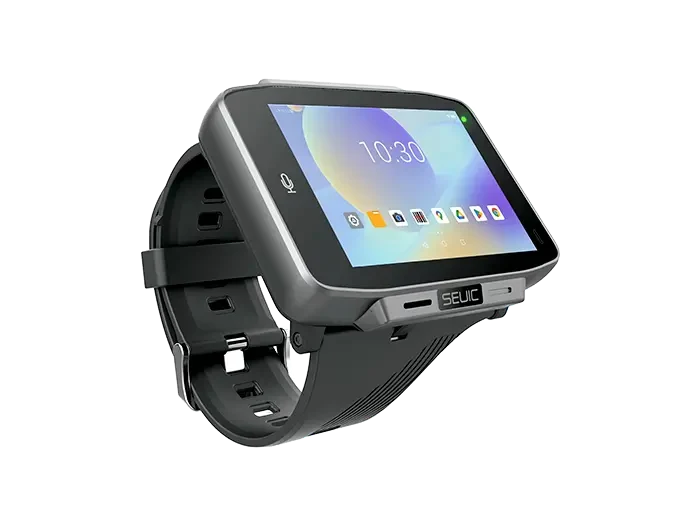
SEUIC (Dongji) / Wearable terminals
AUTOID Swatch: Wearable terminals
SEUIC (Dongji) AUTOID Swatch is a wrist-worn Android terminal for message prompts, inspection and paired barcode workflows. The official page lists a 2.8 inch touch display, 3300 mAh battery, 13 MP rear camera, IP67 protection and a link to the AUTOID Ecard scanner; its healthcare references do not establish medical certification.
Suggested profiles: wrist-worn prompts, inspection, worker communication and paired barcode capture
- Operating system
- Android 9.0
- Display
- 2.8 inch LCD, 640 x 480 pixels, three-point capacitive touch, up to 350 nit
- Battery
- Non-removable 3300 mAh lithium-ion battery
- Protection
- IP67; manufacturer lists 1.2 m marble drop testing
- Wireless
- Dual-band Wi-Fi and GPS family positioning are listed; WWAN configuration requires confirmation
- Processor
- MTK quad-core, 2.0 GHz
Browse by device capability
AUTOID Swatch / Browse by device capability
UROVO is the primary established product resource, with SEUIC (Dongji) and selected platforms used where the capture method, form factor or deployment requirement needs another option. Published models follow an evidence, regional-configuration and RuggedLayer validation path.
Suggested profiles
- Production inspection and task prompts
- Healthcare logistics or SPD workflows without clinical-device claims
- Ticketing or worker workflows paired with a separate scanner
Browse by device capability
- A wrist-worn screen brings task prompts, messages and status information into the operator view.
- The camera, Bluetooth pairing and Ecard relationship can support a coordinated wearable capture workflow.
- IP67 protection, vibration and a 3300 mAh battery are manufacturer-listed starting points for field pilots.
- Android 9 lifecycle, radio scope and wearing comfort need explicit project review.
How a device enters the portfolio
Key specifications
Manufacturer-listed configuration; confirm the exact variant before ordering.
Platform
| Operating system | Android 9.0 |
|---|---|
| Processor | MTK quad-core, 2.0 GHz |
| Memory and storage | 3 GB LPDDR3 RAM / 32 GB storage |
| Display | 2.8 inch LCD, 640 x 480 pixels, three-point capacitive touch, up to 350 nit |
Data capture
| Camera | 13 MP rear camera |
|---|---|
| Sensors | Accelerometer, proximity/light sensor, electronic compass, gyroscope and barometer |
Connectivity
| Wireless | Dual-band Wi-Fi and GPS family positioning are listed; WWAN configuration requires confirmation |
|---|
Power and physical
| Battery | Non-removable 3300 mAh lithium-ion battery |
|---|
Environmental
| Protection | IP67; manufacturer lists 1.2 m marble drop testing |
|---|---|
| Environment | Operating -20 to +60 C; storage -30 to +70 C; 5-95% RH non-condensing |
Other configuration
| Controls and audio | Power and custom buttons, speaker, dual microphones and vibration motor |
|---|---|
| Physical | 54.7 x 80 x 17 mm; approximately 100 g without strap |
A final shortlist depends on the application, scan or RFID workload, operating environment, country, deployment volume and support expectations.
A clear handoff at every layer
Five service layers for a more predictable device program.
RuggedLayer organizes access to multiple manufacturers into a consistent engagement model. Each layer has a defined input, deliverable and evidence boundary.
Service layers
- Define the wrist strap, screen interaction, paired Ecard or host device, radio profile and cleaning process.
- Test application readability, camera capture, Bluetooth reconnect, battery endurance, vibration and operator comfort.
- Review Android 9 security policy, update ownership, data handling and any healthcare privacy requirements before rollout.
Deployment accessories
- Scope the wrist strap, charging cable or dock, screen protection and a spare-device rotation plan.
- Keep the paired-scanner profile, application permissions, notification policy and charging routine with the deployment package.
RuggedLayer Test Lab
Define a useful test, not a vague benchmark.
Tell us the labels, tags, application and operating conditions that matter.
- 01
Run the target task application and camera workflow through a full shift with representative gloves and lighting.
- 02
Measure paired-scanner range, reconnect, battery, touch, audio, vibration and offline recovery behavior.
- 03
Freeze the Android image, wearable configuration, privacy controls, accessories and acceptance record.
Project intake
AUTOID Swatch / Start with enough context to make the next step useful.
Choose the closest project intent and describe only non-confidential workflow, application and deployment requirements.