SEUIC (Dongji) / Wearable terminals
AUTOID Ecard: Wearable terminals
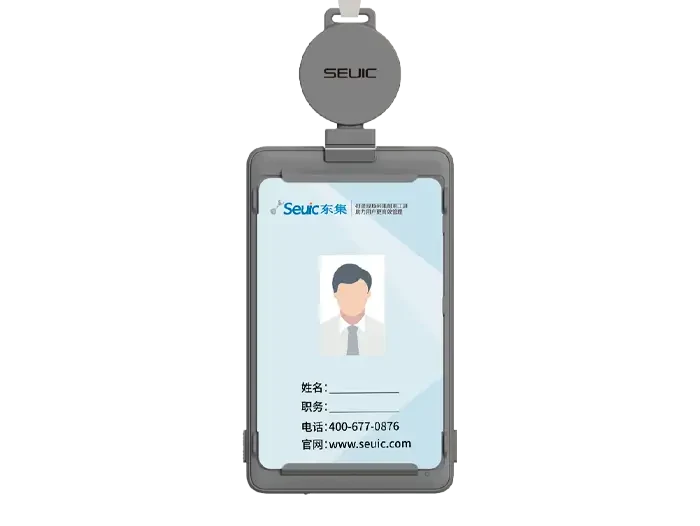
SEUIC (Dongji) AUTOID Ecard is a lightweight wearable barcode scanner designed for hands-busy picking, inspection and ticketing workflows. The official page describes a 55 g badge-style unit with pull-cord scanning, Bluetooth transfer, IP67 protection and up to an 8-hour manufacturer endurance reference.
Suggested profiles: hands-free barcode capture for picking, inspection, ticketing and mobile work
- Scanning
- PDA-class 1D/2D difficult-code decoding is described; exact symbology and scan engine require confirmation
- Battery
- Non-removable 700 mAh lithium-ion battery; the product description references up to 8 hours and workload affects endurance
- Protection
- IP67
- Form factor
- Wearable badge-style scanner with automatic scan illumination when the cord is pulled
- Physical
- 100 x 61 x 8.7 mm at the scanner bulge; 55 g
- Host connection
- Wireless Bluetooth transfer; scanning parameters can be configured through the host
The exact model, regional configuration and commercial terms require project confirmation.
Browse by device capability
AUTOID Ecard / Browse by device capability
UROVO is the primary established product resource, with SEUIC (Dongji) and selected platforms used where the capture method, form factor or deployment requirement needs another option. Published models follow an evidence, regional-configuration and RuggedLayer validation path.
Suggested profiles
- Hands-free warehouse picking and replenishment
- Line-side inspection and ticket or access scanning
- High-frequency barcode work paired with a mobile or wearable host
Browse by device capability
- A small wearable scanner can keep both hands available for picking or inspection tasks.
- Pull-cord activation, buttons, beeper and vibration provide several operator feedback paths.
- Bluetooth keeps the capture device separate from the host application while USB-C supports service and charging.
- Battery life, scan coverage and host pairing must be measured with the real shift workflow.
How a device enters the portfolio
Key specifications
Manufacturer-listed configuration; confirm the exact variant before ordering.
Platform
| Host connection | Wireless Bluetooth transfer; scanning parameters can be configured through the host |
|---|
Data capture
| Scanning | PDA-class 1D/2D difficult-code decoding is described; exact symbology and scan engine require confirmation |
|---|
Power and physical
| Battery | Non-removable 700 mAh lithium-ion battery; the product description references up to 8 hours and workload affects endurance |
|---|---|
| Interface | USB Type-C |
Environmental
| Protection | IP67 |
|---|---|
| Drop reference | Manufacturer lists 1.2 m marble drops across six sides and five rounds |
| Environment | Operating -20 to +60 C; storage -30 to +70 C; 5-95% RH non-condensing |
Other configuration
| Form factor | Wearable badge-style scanner with automatic scan illumination when the cord is pulled |
|---|---|
| Physical | 100 x 61 x 8.7 mm at the scanner bulge; 55 g |
| Controls | Two scan buttons and one power button; manufacturer lists one-million-press button life |
| Feedback | Two-color status LEDs, scan beeper and controllable vibration motor |
A final shortlist depends on the application, scan or RFID workload, operating environment, country, deployment volume and support expectations.
A clear handoff at every layer
Five service layers for a more predictable device program.
RuggedLayer organizes access to multiple manufacturers into a consistent engagement model. Each layer has a defined input, deliverable and evidence boundary.
Service layers
- Define the wearing method, cord route, scan trigger, Bluetooth profile, host device and feedback policy before the pilot.
- Test pairing recovery, scan latency, screen or label codes, gloves, battery turnaround and shared-device hygiene.
- Confirm the exact scan engine, symbologies, charging plan and replacement process before a volume order.
Deployment accessories
- Scope the badge clip or cord, spare charging cables, protective parts and a charging routine for shift handover.
- Document the host pairing profile, scan settings and approved wearing method with the deployment package.
RuggedLayer Test Lab
Define a useful test, not a vague benchmark.
Tell us the labels, tags, application and operating conditions that matter.
- 01
Measure first-pass reads and duplicate events for representative labels, screens, damaged codes and operator motions.
- 02
Test Bluetooth range, reconnect, beeper, vibration, LED states, battery endurance and charging behavior.
- 03
Freeze the scanner profile, host application input contract, wearing method and acceptance thresholds before rollout.
Project intake
AUTOID Ecard / Start with enough context to make the next step useful.
Choose the closest project intent and describe only non-confidential workflow, application and deployment requirements.