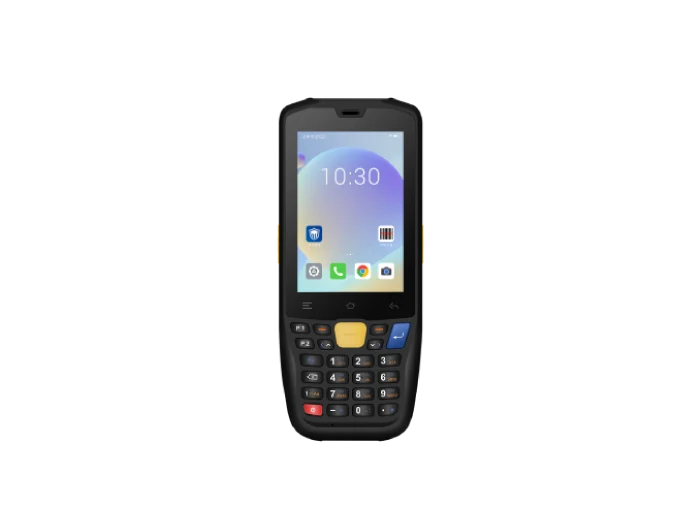
SEUIC (Dongji) / Handheld RFID readers
AUTOID 3U: Handheld RFID readers
SEUIC (Dongji) AUTOID 3U is a compact Android handheld that combines UHF RFID, NFC and barcode capture for office assets, exhibition ticketing and workshop tools. The official page lists a removable 4200 mAh battery, 26 physical keys, IP54 protection and short-range manufacturer RFID references.
Suggested profiles: compact office-asset, workshop-tool and ticketing RFID workflows
- Operating system
- Android 9.0
- Display
- 3.5 inch capacitive display, 320 x 480 pixels
- RFID
- EPC C1 Gen2 / ISO18000-6C; 840-960 MHz; 1-27 dBm adjustable
- Battery
- Removable 4200 mAh lithium-ion battery
- Protection
- IP54; manufacturer lists a 1.2 m drop and 0.5 m rolling reference
- Processor
- MTK quad-core, 2.0 GHz
The exact model, regional configuration and commercial terms require project confirmation.
Browse by device capability
AUTOID 3U / Browse by device capability
UROVO is the primary established product resource, with SEUIC (Dongji) and selected platforms used where the capture method, form factor or deployment requirement needs another option. Published models follow an evidence, regional-configuration and RuggedLayer validation path.
Suggested profiles
- Office asset inventory and tool tracking
- Workshop or production-tool identification
- Exhibition, ticketing and short-range multi-tag workflows
Browse by device capability
- A compact body combines short-range UHF, NFC and barcode capture for mixed asset workflows.
- Physical keys and separate UHF or scan controls support quick operator mode changes.
- The manufacturer range and tag-rate figures fit initial sizing, while actual performance depends on the asset mix.
- Android 9 lifecycle and the compact display should be checked against the target application.
How a device enters the portfolio
Key specifications
Manufacturer-listed configuration; confirm the exact variant before ordering.
Platform
| Operating system | Android 9.0 |
|---|---|
| Processor | MTK quad-core, 2.0 GHz |
| Memory and storage | 2 GB RAM / 16 GB storage; Micro SD up to 128 GB |
| Display | 3.5 inch capacitive display, 320 x 480 pixels |
Data capture
| RFID | EPC C1 Gen2 / ISO18000-6C; 840-960 MHz; 1-27 dBm adjustable |
|---|
Power and physical
| Battery | Removable 4200 mAh lithium-ion battery |
|---|
Environmental
| Protection | IP54; manufacturer lists a 1.2 m drop and 0.5 m rolling reference |
|---|---|
| Environment | Operating -20 to +50 C; storage -40 to +60 C with battery; 5-95% RH non-condensing |
Other configuration
| RF performance reference | At least 0.5 m read, at least 0.3 m write and at least 30 tags/s with stated reference tags |
|---|---|
| Capture | NFC/HF, 13 MP camera and barcode capture are listed for the combined collection workflow |
| Input | 26 physical keys including UHF, scan and mode controls |
| Physical | 158 x 66 x 18 mm, 28.6 mm at the thickest point; approximately 266 g including battery |
A final shortlist depends on the application, scan or RFID workload, operating environment, country, deployment volume and support expectations.
A clear handoff at every layer
Five service layers for a more predictable device program.
RuggedLayer organizes access to multiple manufacturers into a consistent engagement model. Each layer has a defined input, deliverable and evidence boundary.
Service layers
- Confirm the UHF region, NFC behavior, barcode engine, SIM, storage, key mapping and Android application support.
- Test metal or mixed materials, tag spacing, operator grip, screen readability, battery rotation and offline sync.
- Review Android 9 security, MDM, charging, cleaning and replacement policies before deployment.
Deployment accessories
- Scope spare batteries, charger, hand strap, protective cover, USB-C cable and any NFC or barcode accessories.
- Keep the mode mapping, RF settings, scan profile, MDM policy and approved asset-tag samples with the handover.
RuggedLayer Test Lab
Define a useful test, not a vague benchmark.
Tell us the labels, tags, application and operating conditions that matter.
- 01
Measure UHF read, write, missed and stray events with representative short-range tags and materials.
- 02
Test barcode and NFC capture, mode switching, battery, application sync, charging and offline recovery.
- 03
Freeze the exact SKU, OS, firmware, RF profile, input map, accessories and acceptance thresholds.
Project intake
AUTOID 3U / Start with enough context to make the next step useful.
Choose the closest project intent and describe only non-confidential workflow, application and deployment requirements.